White-tailed Eagle reintroduction in Southern England: FAQs
F.A.Q.
Frequently Asked Questions
The project is a partnership between Forestry England and the Roy Dennis Wildlife Foundation. From 2026, White-tailed Eagles will be released from both the Isle of Wight and Exmoor National Park. The project team is supported by local steering groups with representatives from a range of stakeholder groups, including conservation, farming and game shooting.
Juvenile White-tailed Eagles, aged approximately 5-7 weeks, are collected under licence, from nests in Scotland and translocated to the release location in June. They are then held in a quiet, confidential, location for approximately five-six weeks before being released. The eagles are fitted with satellite tags before they are released, to allow us to monitor their movements. Food – mainly fish – is provided close to the release site during the autumn and winter before the young eagles become independent.
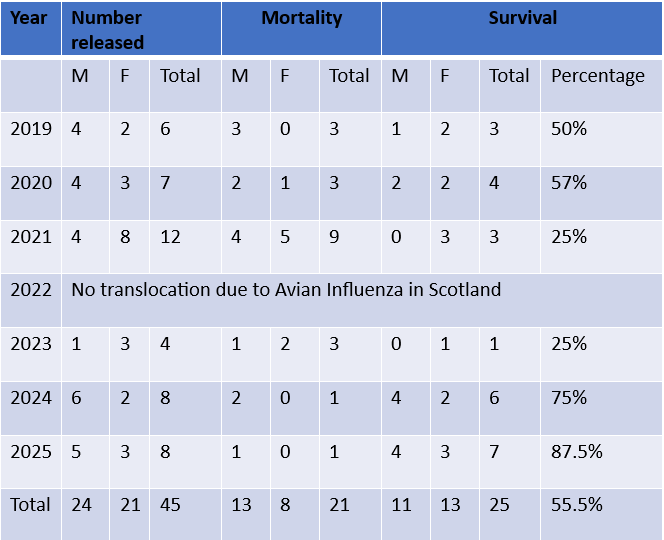
To date, a total of 45 birds have been released, with further cohorts of young birds due to be released in 2026.
The project reached a major milestone in 2023 when a pair of translocated eagles, G405 and G471, raised a chick at a confidential location in Sussex for the first time. The young eagle, G625, was the first to fledge from a nest in southern England for over 240 years. A further two male chicks (G436 and G437) fledged from the same site in 2024, and two females (G841 and G842) in 2025. A second pair of translocated eagles, G466 and G463, bred at a confidential site in Dorset in 2025 with a single male chick, G834, fledging successfully. Three other territorial pairs are now established, all located within the expected natal dispersal range of 60km, including a pair on the Isle of Wight.
In 2026, Natural England granted a further license to release up to 20 White-tailed Eagles over three years from an additional location in Exmoor National Park, following the same methodology as the Isle of Wight releases. In time, re-establishing a population of White-tailed Eagles in southern England will help to link expanding populations in Scotland and Ireland with those in the Netherlands and France. Evidence from lowland Europe, shows that the species will readily nest in densely populated areas, close to people and we have been encouraged by how well the eagles have fitted into the English landscape.
There have been no cases of livestock predation or reports of damage from the game shoots or fisheries since the project began. Several groups from these sectors have representatives on the project steering group, providing them with the opportunity to give their views, and to hear updates from the project team.
In addition to the conservation and ecological benefits of restoring a lost apex predator, we believe that the project will give a significant boost to the Isle of Wight and wider South Coast economy, including in winter. In Scotland eagle tourism is extremely popular and recent reports have shown White-tailed Eagles generate up to £5 million to the economy of the Isle of Mull each year, and £2.4 million to the Isle of Skye.
It is now possible to see White-tailed Eagles in several locations in southern England. The charity Birds of Poole Harbour run boat trips throughout the year to look for eagles and other species at Poole Harbour. They are often rewarded with excellent views of two eagles released in 2020, G463 and G466, which have paired and taken up residence in the local area, as well as others that regularly visit.
Members of the public also frequently observe eagles at RSPB Arne in Dorset and RSPB Pulborough Brooks in West Sussex, which are both nature reserves with excellent visitor facilities. At present, it is not possible to direct visitors to view eagles at specific localities on the Isle of Wight but an MSc thesis undertaken by a student from Kent University found that as many as 10% of visitors list White-tailed Eagles as a reason to visit; not insignificant considering two million people visited the Isle of Wight as tourists in 2022. These encouraging early signs suggest that White-tailed Eagles are likely to contribute positively to the cultural identity and economy of the region in the years ahead. We are delighted that a huge White-tailed Eagle mural by artist Alice Malia, now adorns the Columbine Building in East Cowes on the Isle of Wight.
As a generalist predator White-tailed Eagles favour fish and water birds and scavenge carrion, varying their diet according to whatever is most seasonally abundant. Studies across Europe have shown that fish are favoured when available, particularly in spring and summer, with waterbirds becoming more important in autumn and winter.
We have closely studied the diet of the eagles since the project began and have amassed a very large database of more than 900 feeding observations. This has enabled us to determine what the eagles are eating, and how prey is acquired. This research has shown that carrion is very important for young eagles, but that fish are increasingly favoured as they mature. The White-tailed Eagle’s preference for fishing in shallow water means estuarine areas along the South Coast are favoured fishing grounds, with seasonally abundant species such as Grey Mullet and European Bass, regularly caught. They have also become adept at catching Cuttlefish, which spawn in seagrass beds along the coast. You can read more about the eagles’ diet here.
White-tailed Eagles prefer the ‘sit and wait’ strategy for acquiring food, and satellite tracking data has shown that they spend over 85% of each day perched. Waterbirds become habituated to their presence in estuarine and other wetland sites, and breeding colonies of gulls and terns are effective at mobbing and driving off passing eagles.
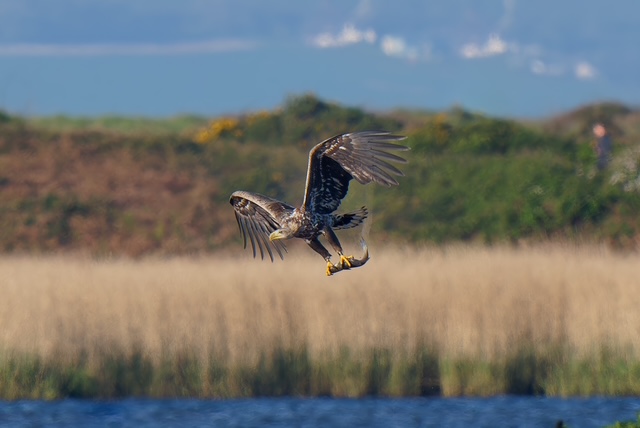
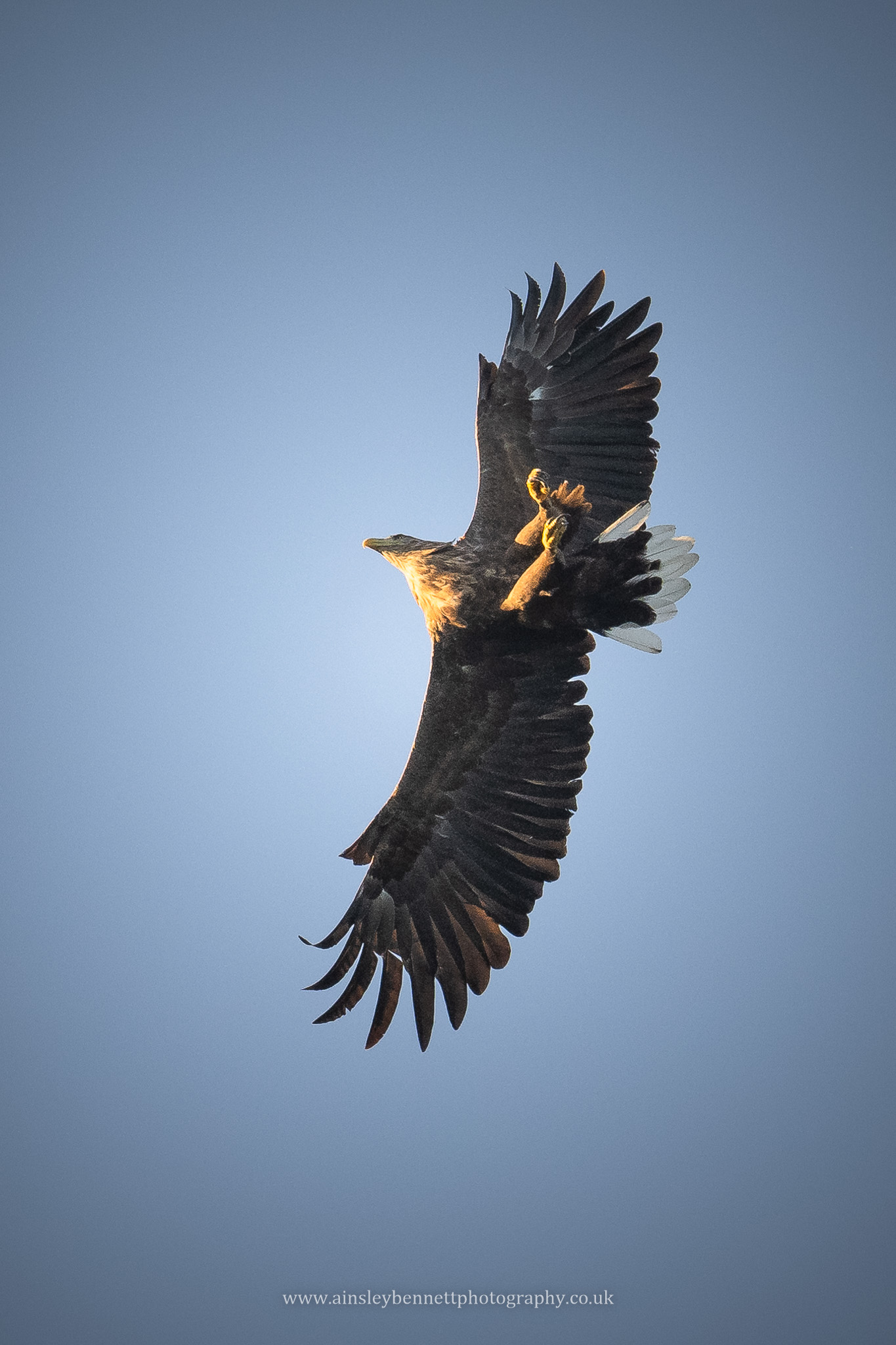
Image by Peter Twamley
A total of 45 juvenile White-tailed Eagles have been released to date and of these birds, 25 are still alive, as shown the table below. This gives an overall survival rate to date of 55.5%. It is encouraging that survival of birds in the two oldest cohorts (50% for 2019 and 57% for 2020) remains higher than expected (c35%) based on corresponding figures for the Scottish reintroduction and that five pairs have now become established in highly suitable breeding localities.
Although almost equal numbers of the sexes had been released by 2023, there had been higher mortality of male birds. As a result, the collection of juveniles in 2024 and 2025 was biased towards males. A further two-three years of releases are planned on the Isle of Wight, so that a total of 60 birds will have been released.
There have a been a range of causes of death, including avian influenza, train strikes, power line strikes and illegal persecution.
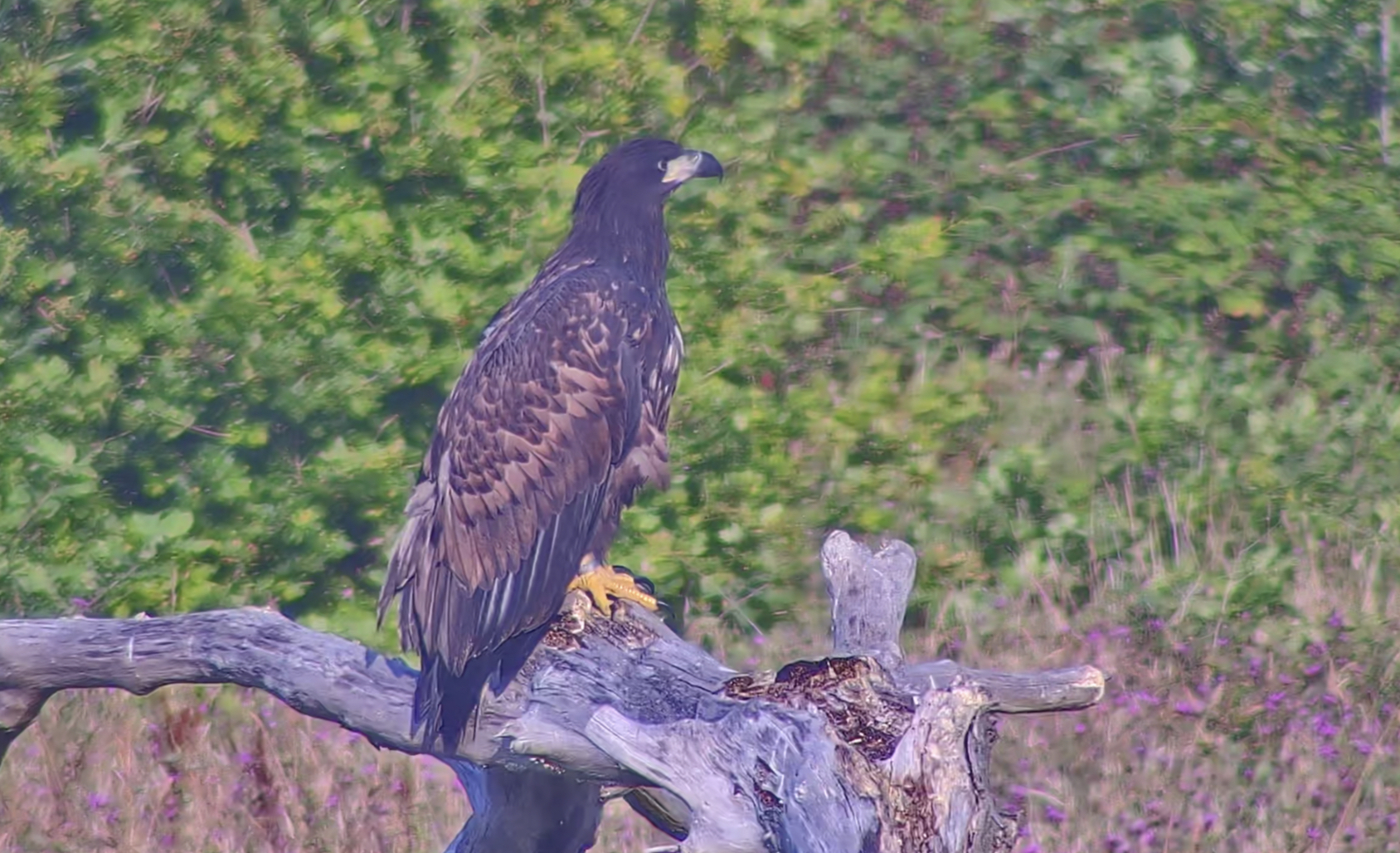
Image: White-tailed Eagle juvenile after release