BAR-TAILED GODWIT IN THE UK
2006 satellite tracking of Bar-tailed Godwit
The Roy Dennis Wildlife Foundation carried out innovative satellite tracking studies for avian species, including the Bar-tailed Godwit, which have gone on to shape further research and restoration efforts. Bar-tailed Godwits are amber listed in the UK.

Bar-tailed godwits are waders, sized between a curlew and a redshank. They have a long, tapering bill that is slightly upturned. The rump is white and the tail brown and barred. There is a white ‘V’ between the wings and a short pale stripe above the eye. The legs are long, with less showing above the joint than on black-tailed godwits. Females are larger than males. In Spring males have a brick-red face, neck and underparts and grey-brown back. They lose these colours after the moult but have a boldly streaked back.
habitat and distribution
Scottish bar-tailed godwits prefer sandy or muddy shores or estuaries but are also found on rocky shores. They breed mainly in the sub-Arctic on tundra, peat mosses and swamps near the coast. They have a fairly wide distribution, being found along coastal areas of large parts of Africa, Australasia, Europe, Russia and India.
diet
Bar-tailed godwits feed mainly on worms and shellfish found in coastal sand, in particular ragworms and lugworms. They also eat shrimps and small marine snails. When on their breeding grounds they eat a variety of insect life, including beetles, flies and moth caterpillars, as well as worms, snails and occasionally berries and seeds.
Reproduction
Bar-tailed godwits breed in the Arctic and migrate from Africa, Australia and Asia Most Scottish birds depart in March and April. They build a nest on the ground, in which the female lays four eggs. Both parents share the 21-22 day incubation period, although the male carries out the majority. After nesting they return south via Europe, some stopping off to moult before continuing to Africa, and some choosing to spend the winter here
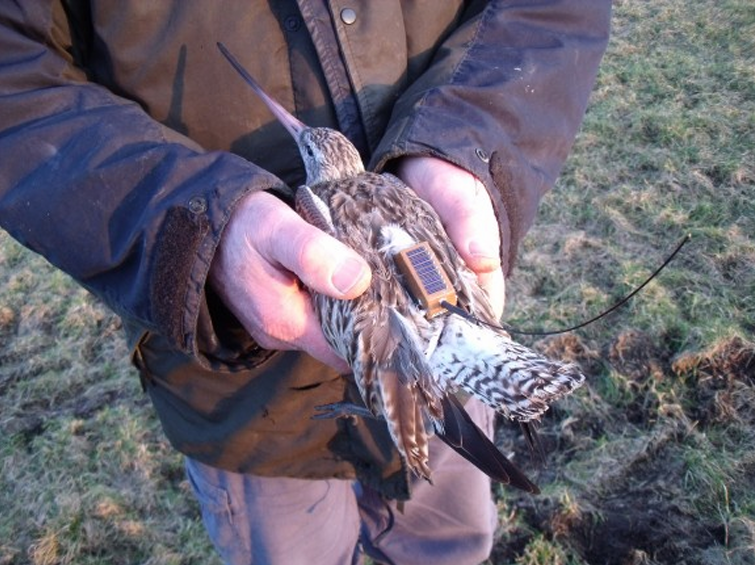
The archives: satellite tagging study – 2006
In 2006, a project on the satellite tracking of bar-tailed godwits was initiated by the Roy Dennis Wildlife Foundation and the Highland Ringing Group, with part funding by Scottish Natural Heritage, to research the migrations of bar-tailed godwits wintering at Whiteness in the Moray Firth,
and to learn more about their use of the Firth in winter and of their breeding areas in the Arctic. In March and April 2009, transmitters were finally fitted to two bar-tailed godwits at Ardersier.