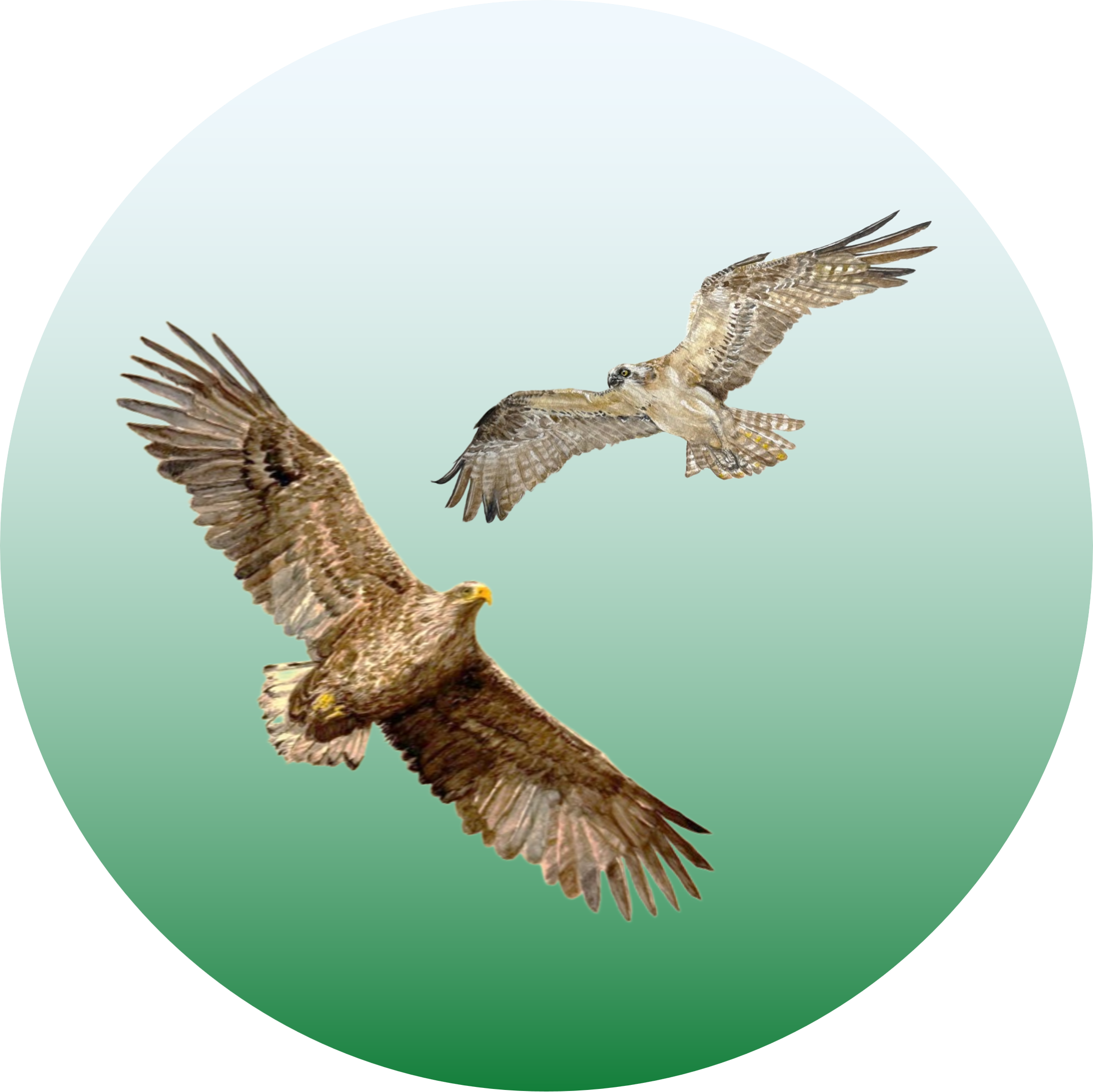
White-tailed eagle
Recovery in Southern England: project history
Follow the history of the White-tailed Eagle Reintroduction project to date, working in partnership with Forestry England.
Number of releases
8
Eagles released
56
Pairs breeding in england
2
Chicks fledged from breeding pairs in england since the project start
7
Image: Ainsley Bennet
Project milestones
2019
The first White-tailed Eagles are released on the Isle of Wight.
2023
White-tailed Eagles successfully breed and fledge a chick in Southern England for the first time in over 240 years.
2024
The successful breeding pair in Sussex rear another two chicks.
Work begins assessing the feasibility of futher releases to assist the recovery of the species in Southern England, beginning in Exmoor. Exmoor National Park launch their first White-tailed Eagle public perception survey.
2025
A second breeding pair of White-tailed Eagles are successful in Dorset, and three White-tailed Eagles fledge from two nests. Multiple territories are now established on the South Coast of England.
2026
Work begins to prepare for the next release on the Isle of Wight, whilst continuing to monitor the released and wild fledged White-tailed Eagles in England.
Natural England grant a license for the further release of 20 White-tailed Eagles from Exmoor National Park over a 3 year period, and the first 6 White-tailed Eagles were released on Exmoor in July, followed by another co-hort of 5 on the Isle of Wight.
White-tailed Eagle news archives
See below for some of the detailed news updates since the project began in 2019.
Image by Claire Norris
2026
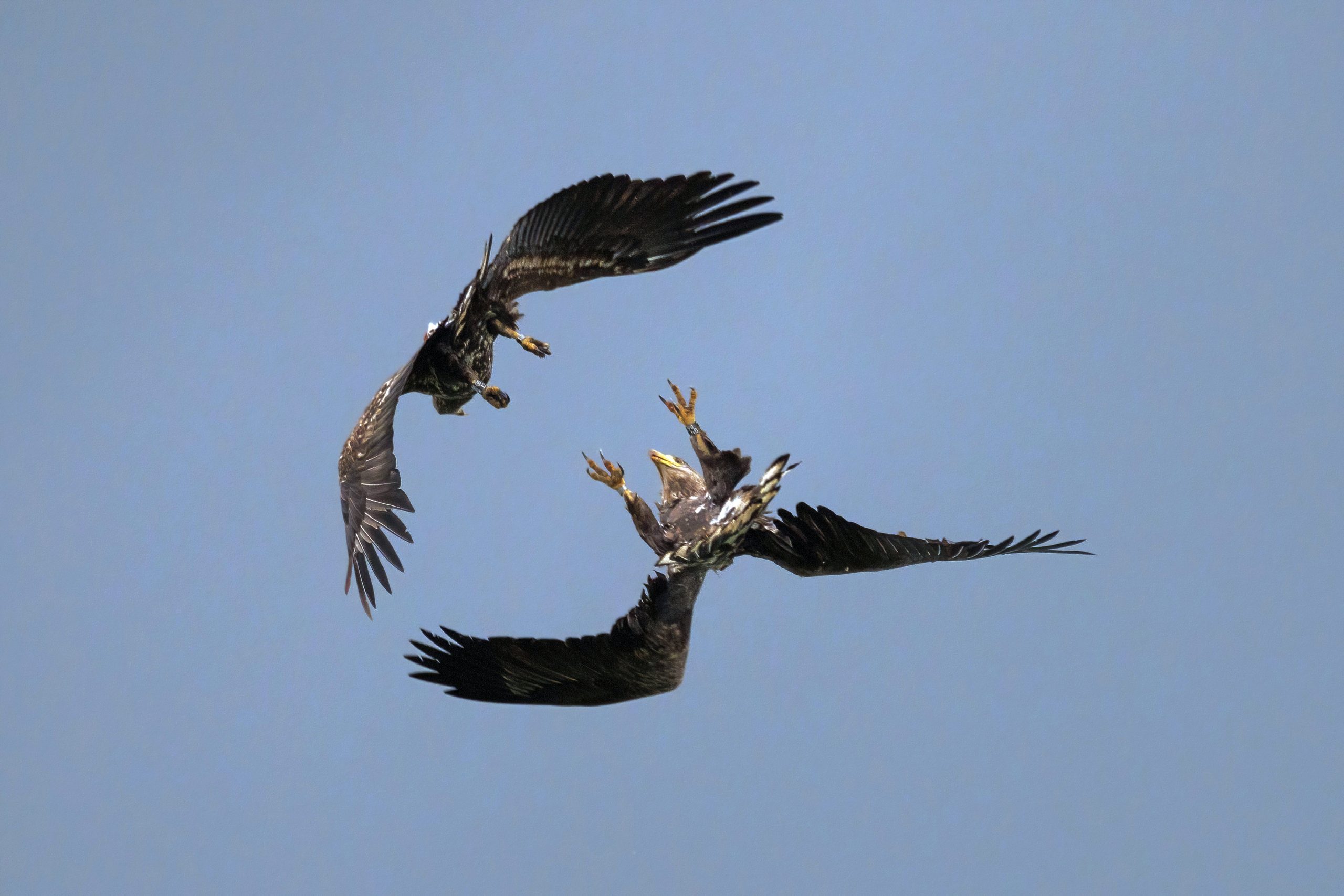
August: 6 White-tailed Eagles successfully released in Exmoor
The return of white-tailed eagles to England has taken another step forward with the release of six young birds in Exmoor National Park, the first to be reintroduced here after they disappeared due to persecution over two hundred years ago. All six eagles are healthy and doing well, as they continue to explore their new environment.
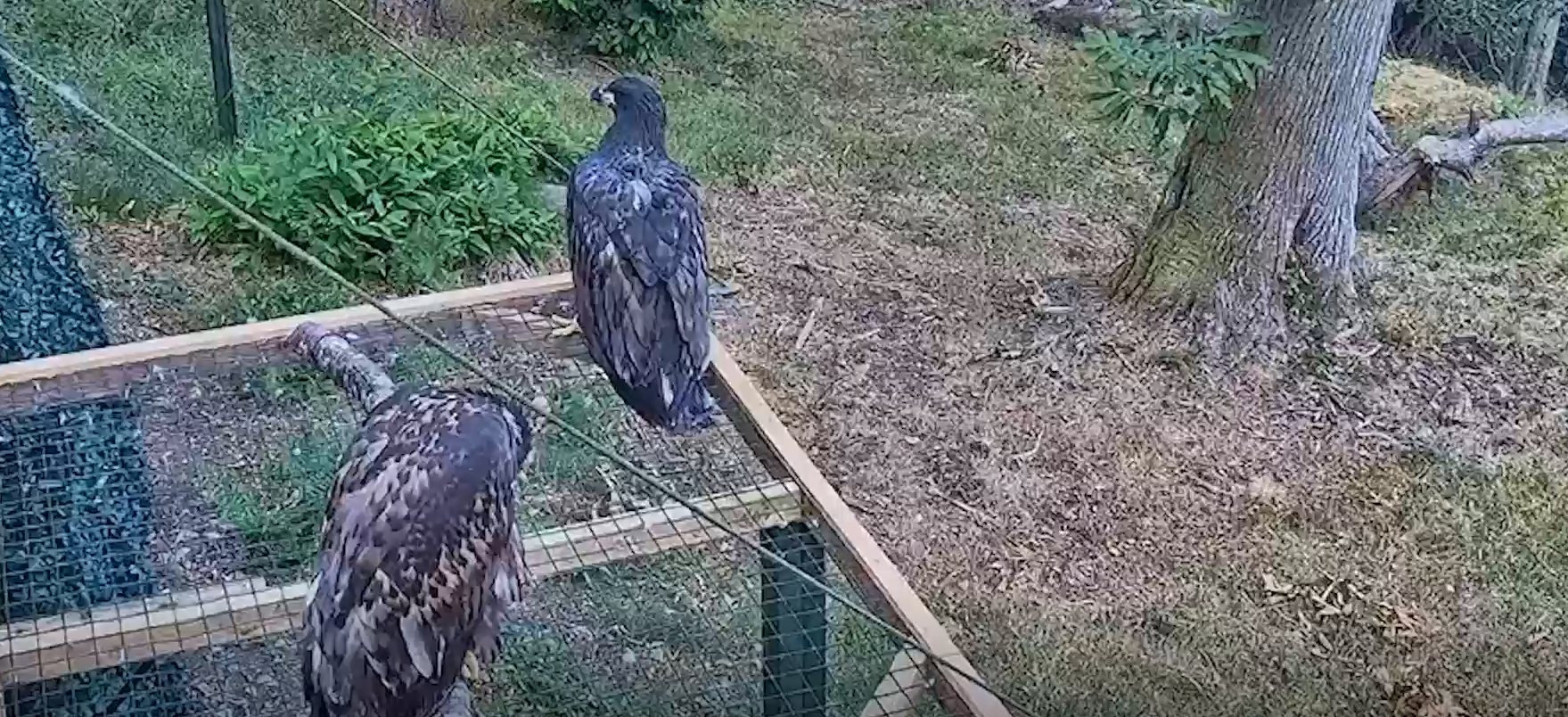
May: additional releases confirmed to begin at Exmoor National Park this summer
The return of Britain’s largest bird of prey, White-tailed Eagles, to the South of England is to be boosted this year following approval on the 13th of May by Natural England, the Government’s wildlife licencing authority, for more of these iconic birds to be released.
2025
April: G542’s adventure to France
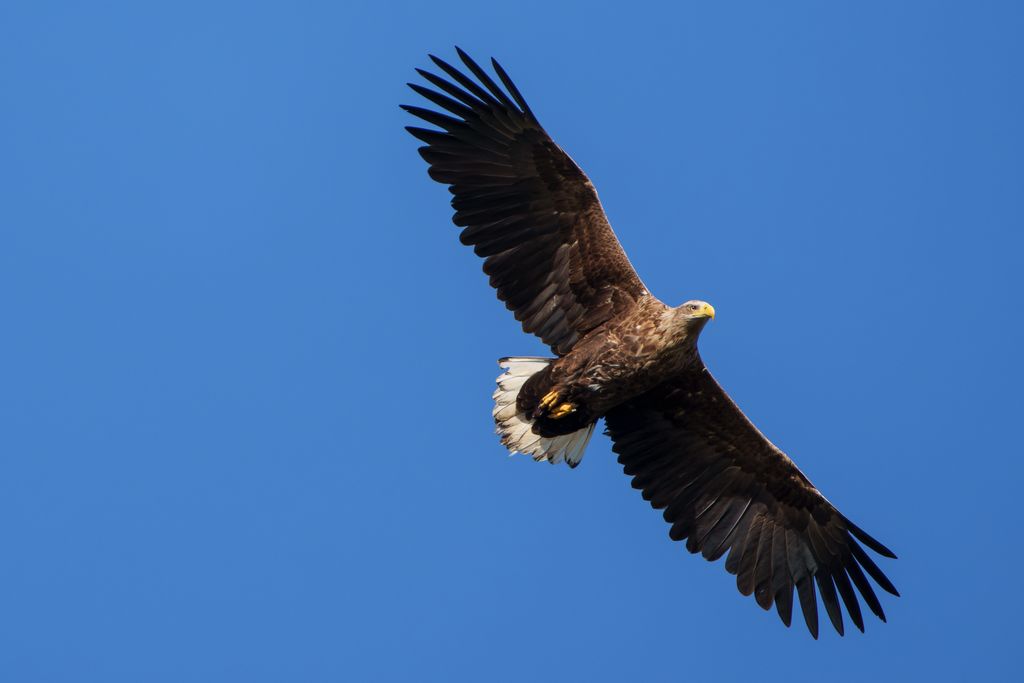
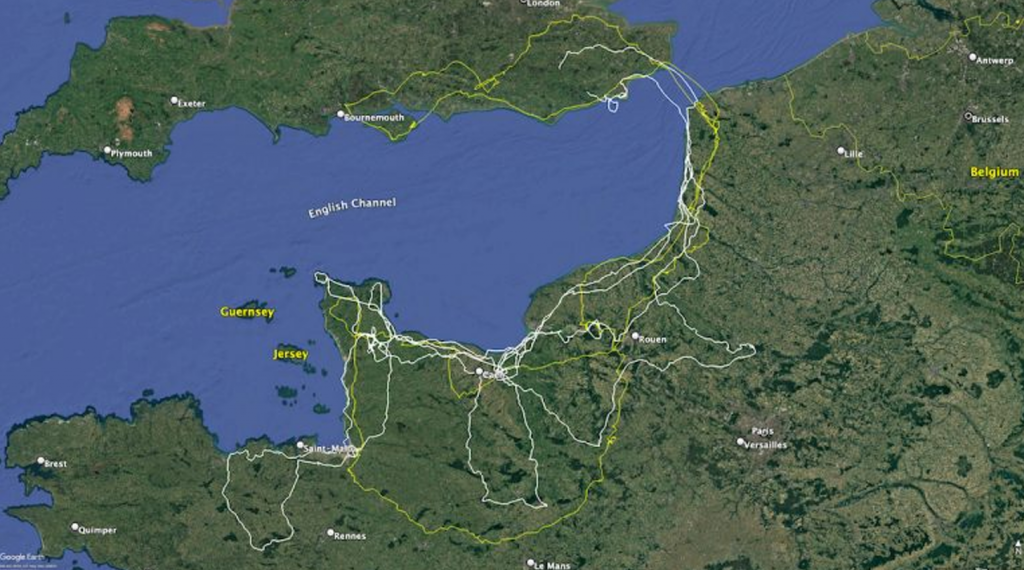
Like many of the unpaired eagles G542 has divided her time between various favoured locations in Southern England over the past twelve months, including East Sussex, Colliford Lake on Bodmin Moor in Cornwall, and also the Isle of Wight. On 13th March G542 headed east along the South Coast. The satellite data shows she spent time circling over the sea between Hastings and Dungeness, and then, as she approached Folkestone, she headed more purposefully out into the English Channel, aided by a helpful northerly tailwind. It is likely that from her altitude of 528 metres on a bright clear day, she could see the French coast, and she eventually made landfall at Bounlogne-sur-Mer, having flown 55km in 75 minutes.
G542 subsequently travelled south-west along the Normandy coast, just as another translocated eagle, G818, had done last spring. She continued west across the Cherbourg peninsular, and reached Brittany on 17thMarch. It seemed she was heading for the west coast of France, but next day, as she approached Ploërmel, she made a 90 degree turn to the north, and travelled back to the north coast near Saint-Brieuc. Once there she changed direction again, following the coast east back into Normandy.
After spending three days along the River Douve on the Cherbourg peninsular, G542 continued east along the Normandy coast on 23rd March, before cutting inland towards Paris, and then north-east to Beauvais. She was now a considerable distance inland, but on 29th March she headed north-west from Beauvais towards Dieppe, and then followed the coast north to Le Touquet, just south of Bounlogne-sur-Mer. It seemed she was going to attempt the return crossing, but with winds not favourable she remained on the Normandy coast on 30th, and then began heading south-west again on 31st .
On 5th April G542 reached the most northern tip of the Cherbourg peninsular, at Pointe des Groins. She was now almost due south of the Isle of Wight, but a 105km sea crossing would be dangerous for a heavy bird like a White-tailed Eagle to undertake. Perhaps recognising this, she moved south again, passing Caen on 7thApril before travelling another 100km south to Mamers on 10th. She made the return flight back to Caen on 11th, and then began moving north-east through Normandy once again. After roosting near Blangy-sur-Bresle on the River Seine on 13th April, G542 continued north the next day, passing over Bounlogne-sur-Mer at 11:30 and then setting off back across the English Channel from Wissant, at 12:20. The 34km crossing from Wissant to Dover took just 35 minutes to complete with favourable tailwinds. Once back in England, G542 returned to a favoured area in East Sussex, having flown 250km that day.
Overall G542 flew 3277km (2036 miles) in just over a month. Her flight was very similar to that of G818 last year, who 2062 km (1281 miles) in 22 days between 22nd March and 8th April. The flights of the two birds are shown in the map below (G542 – white, G818 – yellow).
September: Three White-tailed Eagle chicks fledge in England in 2025
A record three White-tailed Eagle chicks have successfully fledged from two wild nests in England. The chicks were reared by White-tailed Eagles released in a ground breaking conservation project by Forestry England and the Roy Dennis Wildlife Foundation to return this lost species to England. Two different pairs of White-tailed Eagles successfully bred this year. This included the first chick in Dorset for over 240 years, and two chicks raised in a nest in Sussex.
A single male chick (G834) fledged from a nest in Dorset. The parent birds – G463 and G466
released in 2020 – settled in the county and paired up in 2023. This is their first successful breeding attempt and made more remarkable by the fact that the male adult bird has only one leg after it lost this four years ago.
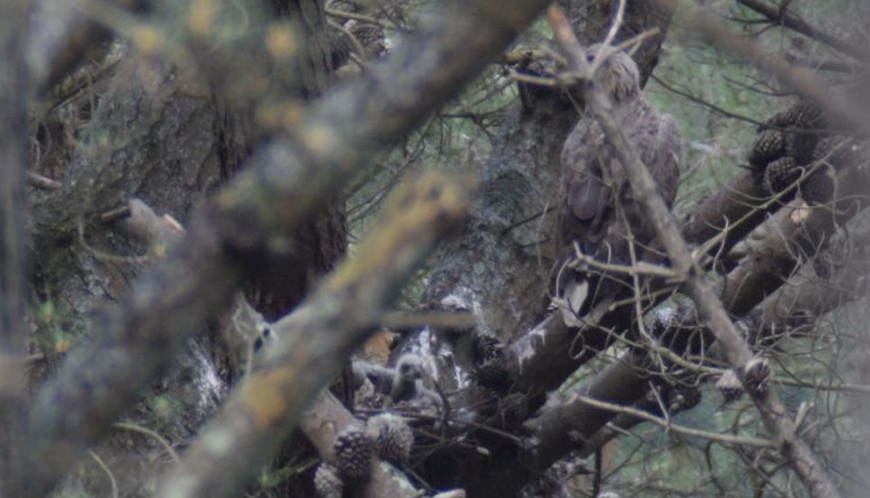
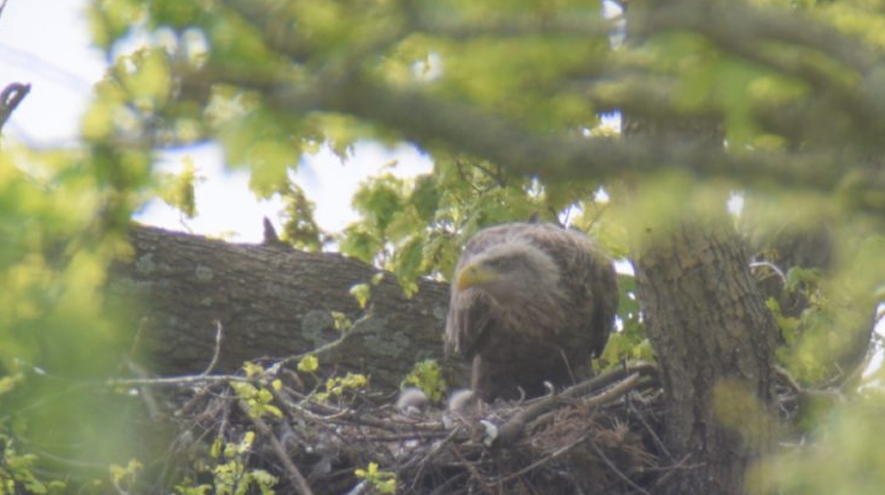
The Dorset chick, aged approximately 2.5 weeks, on the nest with the adult female G466.
Two chicks, both females (G841 and G842), fledged this year from a nest in Sussex. Both are the offspring of two White-tailed Eagles released by the project in 2020. The parent birds – G405 and G471 – were the same pairing that bred in 2023 and 2024.
This year’s successful breeding brings the number of these iconic birds born in the wild through the project to six. In 2023 a single chick was born, the first in England since the eighteenth century when the species was lost due to persecution. A further two chicks fledged in the summer of 2024. All of the chicks are fitted with satellite tags so that the project team can track their progress.
Over the last year they have used satellite data to follow the fledglings as they have explored widely across the UK. White-tailed Eagles typically reach breeding maturity at around four or five years old. From the birds released by the project, three pairs have formed and established territories in southern England. Several of the younger birds are also present in potential future breeding areas typically close to freshwater wetlands or the coast, where the birds can catch fish, which is their preferred food.
In time, it is hoped that a population of 6-10 breeding pairs will become established within 60 kilometres of the release site on the Isle of Wight.
Roy Dennis OBE, Founder of the Roy Dennis Wildlife Foundation, said: “We are delighted to see another year of successful breeding and that two pairs have now reached this key stage. This is a long-term project, and it will take some years before the population is fully restored but the progress made over the last year has been incredibly encouraging. We have some
well-established pairs and two that are actively breeding. We hope to build on this progress, and I’m really pleased that we have been able to release an additional 8 birds this year to further boost the population.”
“I always find it particularly rewarding to see so much support for these magnificent birds and the positive impact they are having on so many people’s relationship with the natural world.”
December: Three White-tailed Eagles disappear in suspicious circumstances
The public are being asked to help the police investigate the suspicious disappearance of three White-tailed eagles. The cases include a chick born in the wild earlier this year in Sussex, one of the first white-tailed eagles to fledge in England for hundreds of years.
The missing birds are part of a project led by Forestry England and the Roy Dennis Wildlife
Foundation to reintroduce this lost species to England.
Their disappearance is being investigated by several police forces and the National Wildlife Crime Unit. The return of white-tailed eagles to England is one of the country’s key conservation successes over recent years. Since 2019, 45 white- tailed eagles have been released. Several breeding pairs have formed with six chicks being born in the wild for the first time since the 1780’s.
Any targeting of the birds will potentially impact the long-term success of the project.
All of the released birds are tagged with satellite trackers allowing the team to closely follow their location and movements. In September the trackers of two eagles were found dumped close to the birds’ last recorded location. Both had been cut off the birds using a sharp instrument. In the case of another eagle, its tag has stopped sending data. The last message received from the device was on 8 November and no sightings of the bird have been recorded since then.
Tim Mackrill from the Roy Dennis Wildlife Foundation said: “We monitor the satellite data,
showing the bird’s minute-by-minute movements, on a daily basis and always investigate any suspicious or unusual data. It was devastating to find the stolen and dumped tags, particularly for the chick in Sussex who fledged this summer and had only just begun its life. So many people in the area had shared the joy of seeing these birds breed again after hundreds of years and our ongoing monitoring has shown how well they were fitting into the landscape. To have that destroyed just a few months later is deeply shocking.”
Steve Egerton-Read, White-Tailed Eagle Project Officer for Forestry England, said: “We are
returning this lost species to the English landscape and have had so much support from the public. These special birds are helping people connect with natural world and showing how with a little bit of help nature can thrive. We are asking the public to show this support again by encouraging anyone who has information that may help the police investigation to come forward.”
There was tremendous public support and local pride this summer when two white-tailed eagle chicks fledged from a nest in Sussex. Both were the offspring of eagles released by the project in 2020 and the first pair to successfully breed in England for over 240 years. The two chicks had spent the first few months of their lives exploring the local West Sussex area.
On 26 September, a satellite tag belonging to one of the chicks (G842) was recovered from the River Rother, near Petersfield. It had been removed from the bird using a sharp instrument. Searches in the area to try and locate the body of the bird have so far been unsuccessful. Sussex police are appealing for information from anyone who was in or around Harting Down and Petersfield on the evening of 20 September 2025. Any members of the public who may have seen the bird or any suspicious behaviour can contact them on 101 or 0800 555 111 quoting incident number 769.
Dyfed Powys Police are investigating a similar incident on 13 September, where a satellite tag
belonging to white-tailed eagle G615 was recovered in remote moorland. The tag had been removed with a sharp instrument before being hidden in an attempt to dispose of it. Searches in the area to try and locate the body of the bird have so far been unsuccessful.
The force is interested in hearing from anyone who was at or around the Gwgia Reservoir, Tregynon between 11am and 1pm or on access land near Bryn y Fawnog between 12 noon and 3pm on 13 September. Callers should quote crime reference number 137. In a third incident, concerns are growing for G819 after its tag, which usually transmits the data daily,
has stopped working. The last transmission was sent on 8 November in the Moorfoot Hills area.
Police Scotland are treating the disappearance as suspicious and asking anyone with information to contact them on 101 or 0800 555 111 quoting incident number PS-20251215-1347.
The reintroduction of white-tailed eagles is conducted under licence from Natural England, the Government’s wildlife licensing authority. White-tailed eagles are a protected species under the Wildlife and Countryside Act (1981). Disturbing, destroying or interfering with them and their nests are criminal offences.
2024
April: G818’s 2062km journey
Since the start of the White-tailed Eagle project, satellite tracking has shown how nomadic the young eagles can be prior to settling on a breeding territory. For example, one of the birds now established at Poole Harbour, male G463, spent two successive summers in continental Europe, before returning to the South Coast and pairing up with female G466. Up until a few weeks ago G463 was the only one of the Isle of Wight eagles to cross the English Channel, but at the end of last month G818, a female that was released in 2021, having been translocated from the Isle of Lewis, followed suit, spending just over a fortnight wandering extensively in northern France, as Tim Mackrill explains.
Although so far unpaired, G818 has been favouring the Avon valley on the Dorset-Hampshire border in recent months and has been regularly seen catching grey mullet in Christchurch Harbour. On the morning of 22nd March she left a favoured area and then flew south across the Isle of Wight, before spending the afternoon at RSPB Brading Marshes. It is not uncommon for the young eagles to visit the Island, but they are usually seen off by the resident pair, G274 and G324, quite quickly and so it was no surprise when G818 crossed the Solent at 9:00 next morning. Once over the mainland G818 tracked east along the South Coast, passing over Brighton at 10:00, Eastbourne half an hour later, and Hastings just before 11:00.
At 12:13 she was over the sea at St Margarets Bay, just to the east of Dover, and while circling at 665 metres, would have been able to see the French coast at Calais. She flew 35 km (21 miles) across the English Channel in 30 minutes, with her altitude dropping from a high of 804 metres off the English coast to 255 metres as she made landfall west of Calais.
Once she reached France she headed south through des caps et Marais d’Opale Regional Natural Park and eventually roosted to the east of the market town of Desvres having flown 301 km (187 miles) since leaving Brading Marshes that morning.
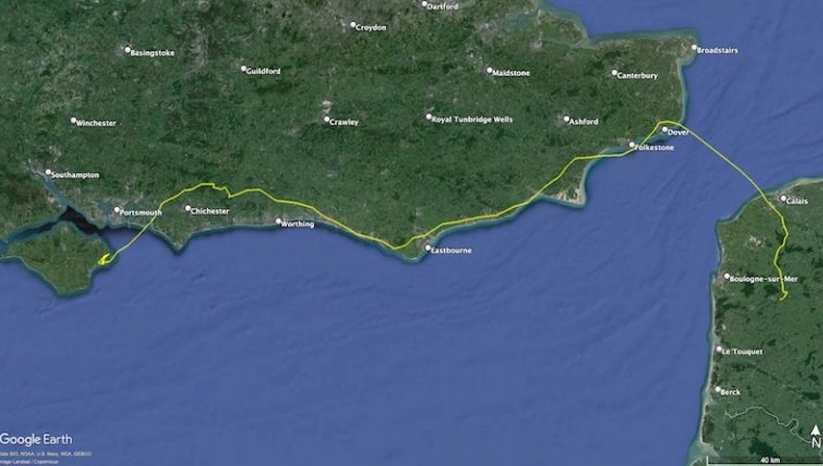
G818 flew 301km to Northern France on the 23rd of March
G818 continued south at first light next morning, before crossing into Normandy at 12:55. She
continued to track the Normandy coast for the next three days, passing Rouen at lunchtime on 25th, and Caen the next day. Eventually she then reached the wetlands of Parc des Marais du Cotentin in the Cherbourg Peninsular during the afternoon of 28th, having flown a total of 454 km (282 miles) in four days.
On the morning of 30th March G818 flew north towards the northern tip of the Cherbourg peninsular. However, she turned around as she approached Cherbourg and then headed south along the west coast. She roosted that night near Mont Saint-Michel in the south-west of Normandy having flown 189 km (117 miles).
G818 moved a few kilomteres south into Brittany on 31st March and spent the day at the wetlands of Réserve Naturelle Régionale du Marais de Sougéal. She was still there next morning and was photographed hunting wildfowl by Maude Bachet.
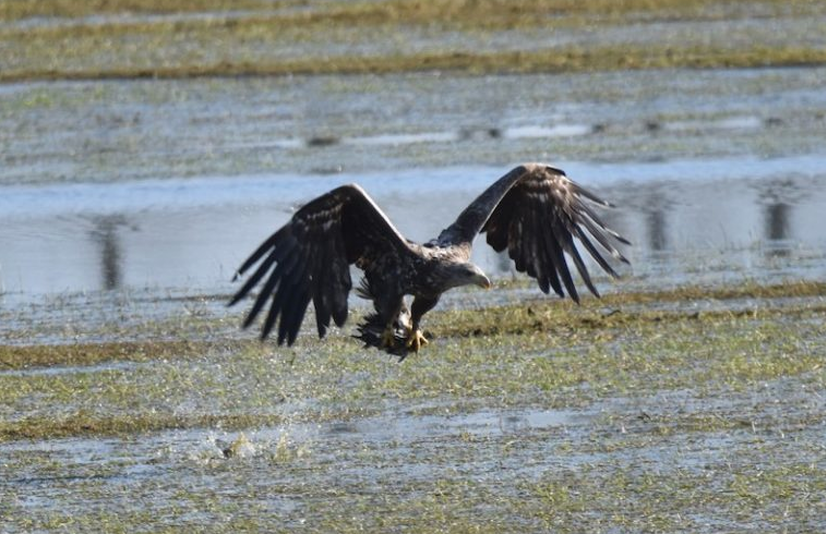
G818 was observed hunting wildfowl at du Marais de Sougeal, photographed by Maude Bachet
G818 left the wetlands at 10:45 on 1st April, initially heading south-east towards Le Mans, beforeturning to the north-east during the afternoon. She flew 224km (139 miles) before roosting in woodland near Longny-les-Villages in the Perche Regional Natural Park. It appeared from this significant flight and change of direction, that she might be beginning to head for home. She moved a little further north on 2nd and then remained near Verneuil d’Avre et d’lton on 3rd. Then, on 4th, she made a more purposeful flight north, travelling 77 km (48 miles) to the River Seine just to the west of Rouen in Normady. She lingered beside the Seine all day on 5th and then during the morning of 6th, before moving 32 km (20 miles) north that afternoon and roosting in the grounds of Château de Cany.
Next morning G818 left the Château at 9:30 and then followed the Normandy coast north-east, passing over Dieppe at 10:30 and eventually reaching Wissant just to the west of Calais at 13:10. Conditions obviously weren’t conducive to a Channel crossing because she headed back inland, before roosting in an area she had first visited on 23rd March, after a day’s flight of 227 km (141 miles).
Next morning, on 8th April, G818 flew back to the coast and then time headed out across the English Channel, 11 km south-west of where she had made landfall on 23rd March. She took 27 minutes to make the crossing, arriving over Dover at an altitude of 109 metres at 12:40.
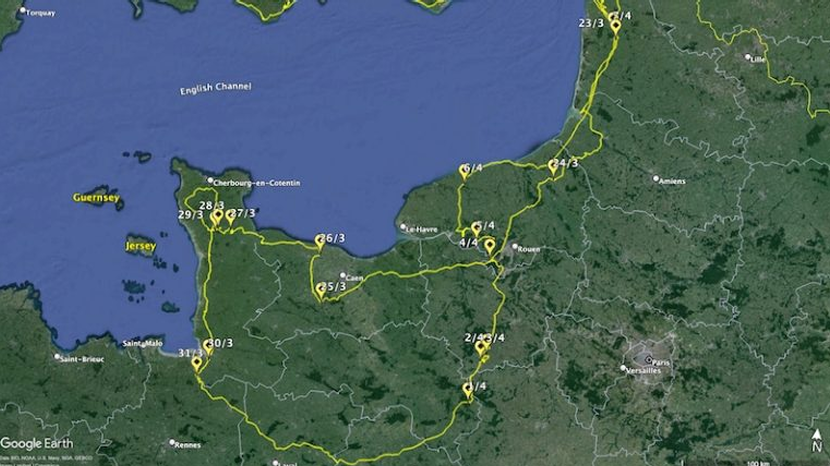
G818’s explorations in France with roost sites (and dates) shown
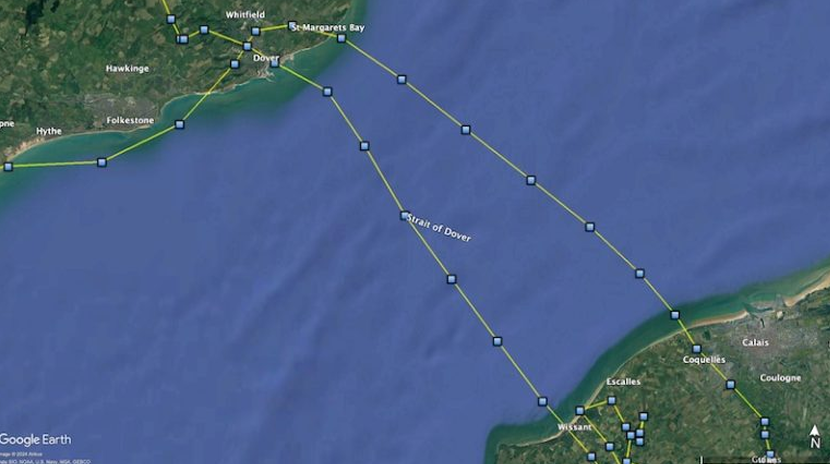
G818’s English Channel crossings on 23rd March (easterly) and return on the 8th of April.
She then continued north, stopping briefly on the Isle of Sheppey at 14:15 before heading west and skirting around the south side of London before roosting south of Oxted in Kent, having flown 196 km (122 miles) from northern France.
Over the course of the next three days she continued west through the South Downs, and then the New Forest, before arriving at a favoured location in the Avon valley at 08:30 on 12th. She had flown a total of 2062 km (1281 miles) in 22 days. A remarkable flight for a young eagle learning her place in the world.
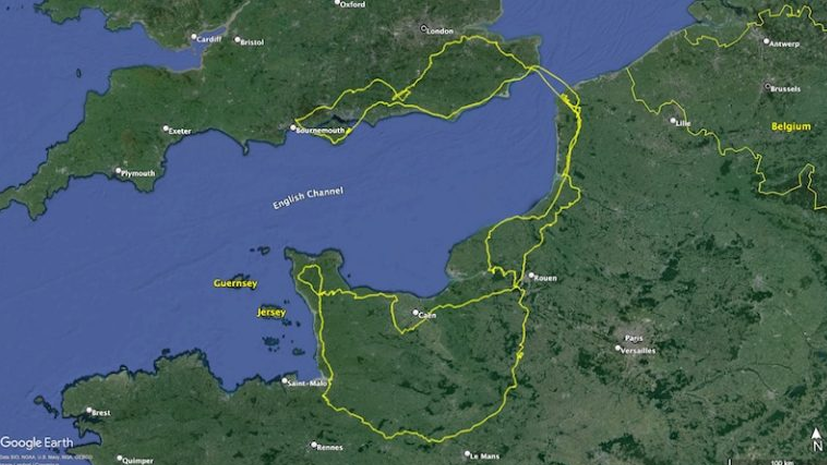
G818’s 2062km journey in 22 days
May: G625’s exploration since fledging in 2023
After leaving his parent’s territory on 6th January, G625 dispersed to Wiltshire before moving northeast to East Anglia in late January. He spent the next two months in Norfolk and Suffolk, favouring the Brecks near Lakenheath and also an area to the north-east of Bury St Edmunds in Suffolk, where he was seen in the company of a colour-ringed Dutch White-tailed Eagle WN88. G625 was also observed catching fish at Suffolk Wildlife Trust’s Mickle Mere Nature Reserve on a number of occasions. During February the young male also spent time in North Norfolk, visiting Holkham NNR and also frequenting an area near Flitcham.
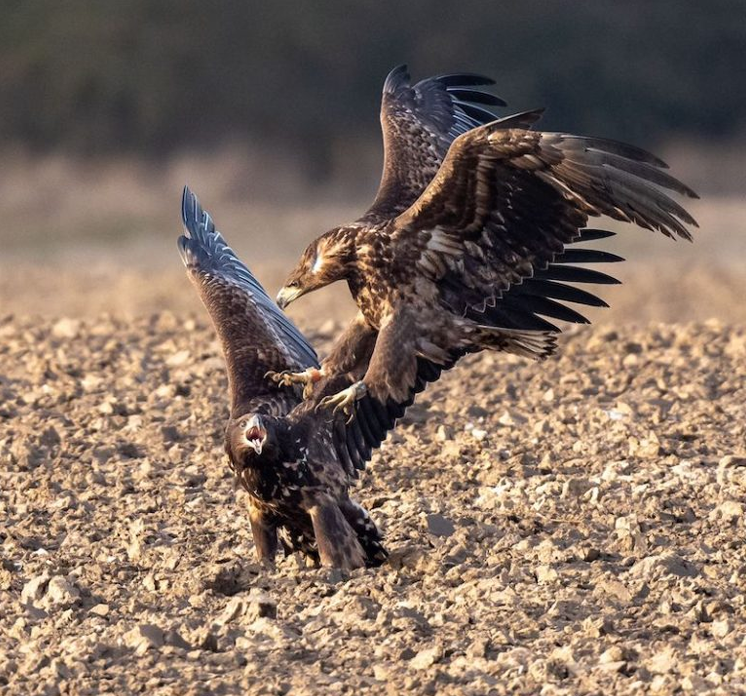
G625 (left) and Dutch White-tailed Eagle WN88 in Suffolk (photo by Su Cross)
G625 left East Anglia on 26th March and flew north to the Lammermuir Hills in the Southern Uplands of Scotland, travelling 660km over the course of five days. Interestingly G625’s father G471 had spent the spring of his second calendar year in East Anglia, before flying north to the Southern Uplands where he remained for much of the summer.
G625’s visit was more short-lived; he remained in the Lammermuirs until 11th April before heading south again, making a 667km return flight to the Brecks, again in five days, arriving in his favoured area near Lakenheath on 15th April (see map).
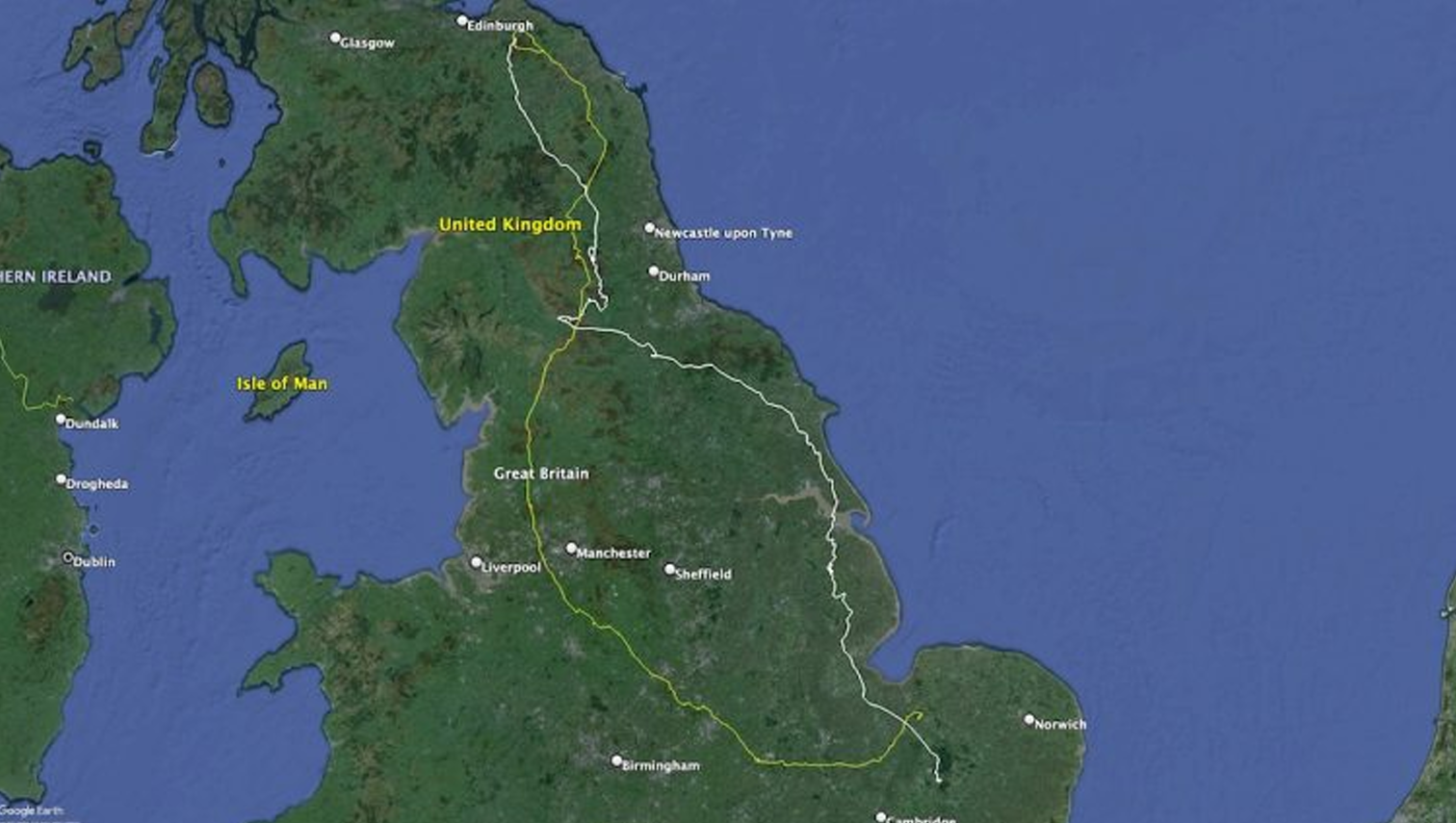
G625’s return flight to the Lammermuirs (yellow = flight north, white = flight south)
This time G625 did not linger in East Anglia for long and instead returned to his natal nest on
17th April, before visiting the Isle of Wight on 18th April and again on 22nd– 23rd April. His return to the South Coast was a brief one though because on 29th April he flew 299km back to North Norfolk from the Knepp estate in West Sussex.
Next day G625 continued north, heading across the Wash and then onwards through Lincolnshire and Yorkshire, before arriving in the North York Moors after a day’s flight of 234km. G625 lingered in the North York Moors for four days before continuing further north, passing through Teeside on 5th May and then reaching the Southern Uplands near Langholm the next day.
On 7th he returned to the Lammermuirs, but only spent two further days there before he was on the move again. G625 crossed the Firth of Forth just before midday on 10th, and then continued north to the Scottish Highlands. That night he roosted in a plantation south of Dufftown in the north east of the Cairngorms having flown 280km.
On 11th May G625 explored Moray, flying north towards Fochabers, before returning south into the mountains again. The young male has remained in the Cairngorms since, favouring an area in the south-east of the national park, ranging between Glen Cova and Glen Lethnot in the Angus Glens. It will be fascinating to see how long G625 remains in northern Scotland. It is possible he will linger north of the border for the rest of the summer, as several of the translocated birds have done. In fact, G641, a male from the Isle of Lewis that we translocated to the Isle of Wight last summer, has also been in the Cairngorms since 7th May, having departed the Isle of Wight on 18th April. The two males met each other just after midday on 11th April and then roosted together that night on the Moray Aberdeenshire border in the eastern Cairngorms, south of Bracklach.
Next day G625 moved further south to the Angus Glens, while G641 has been favouring the mountains between Cabrach and Cock Bridge since. We will continue to monitor their satellite tracking data closely. The tags provide very high resolution data for both birds – a GPS location every 5 minutes – and we will report further interesting movements.
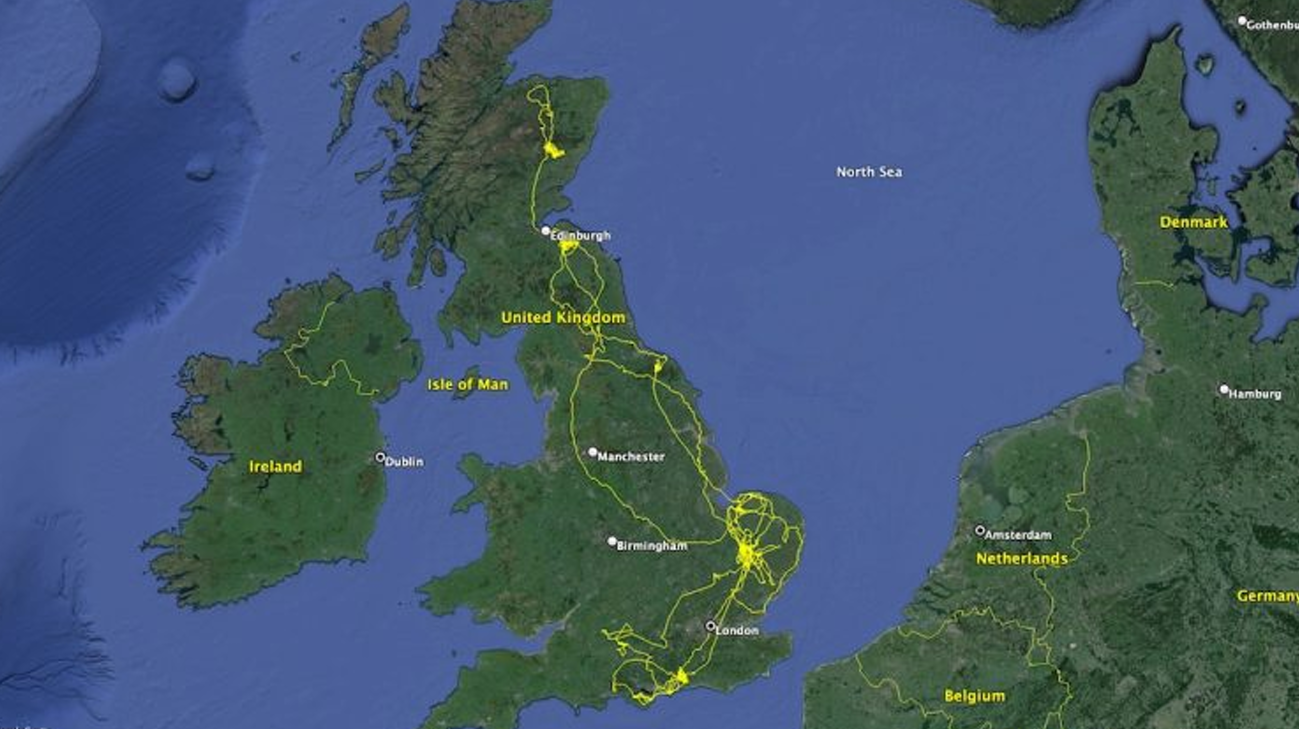
G625’s movements in 2024
Two White-tailed Eagles fledge in 2024
Two white-tailed eagle chicks have fledged from a nest in England, only the second time these iconic birds have bred here for over 240 years. The chicks were reared by a pair of white-tailed eagles released by Forestry England and the Roy Dennis Wildlife Foundation’s project to return this lost species to England.
The chicks, both males, are the offspring of two white-tailed eagles released by the project in 2020. The parent birds – female G405 and male G471 – were the same pairing that last year successfully raised a single male chick (G625), the first white-tailed eagle to be born in southern England since 1780.
The two chicks – G636 and G637 – are fitted with satellite tags so that the project team can track their progress. Over the last year they have used satellite data to follow last year’s chick (G625) as he has explored widely across the UK travelling as far as the north of Scotland.
White-tailed eagles typically reach breeding maturity at around four or five years old. From the birds released by the project, four pairs have now formed and established territories in southern England. It is hoped that these other pairs will breed in future years.
Roy Dennis OBE: “Restoring a breeding population in southern England, where the species was once widespread, has been our ultimate goal. So, to see this second year of breeding success is really encouraging. It is still early days, but this is a very significant milestone.
“We are always so heartened to see the support of so many people towards these magnificent birds and the positive reactions those lucky enough to have seen one have. This success demonstrates our ability to restore nature, including very large iconic species; nature recovery requires even greater effort from us all.”
November: Press release from Exmoor National Park
Exmoor National Park Authority (ENPA) is launching a white-tailed eagle public perception survey and engagement events, to share how it’s partnering with the ‘White Tailed Eagle Reintroduction Programme’ in England led by the Roy Dennis Wildlife Foundation RDWF and Forestry England, to support conservation of the species.
From 2019 onwards the Roy Dennis Wildlife Foundation and Forestry England have been working to restore white-tailed eagles to southern England, through a reintroduction project based on the Isle of Wight, which is licensed by Natural England and NatureScot. A total of 37 eagles have been released to date and in 2023 a pair bred successfully for the first time. The same pair reared a further two chicks this year, and three other territorial pairs of eagles are now established on the South Coast. It is hoped that this project will lead to the establishment of 6-8 pairs of white-tailed eagles within 60km of the Isle of Wight. To support the existing population of these incredible birds the project aims to carry out a small number of additional releases of white-tailed eagles and is working with ENPA to achieve this in the Exmoor National Park.
The hope is that these birds will boost the emerging population of white-tailed eagles along the south coast of England. The area has been identified as a key location after the presence here of several of the white-tailed eagles released by the project. Satellite tracking shows precise locations of the birds and, over the past few years, Exmoor has become a white-tailed eagles hotspot, with seven different birds visiting. Many people have also been lucky enough to see the birds and logged their sightings.
White-tailed eagles formerly bred on the coast of Exmoor and the extensive areas of coastal
woodland and abundant marine fish species, such as grey mullet, provide exceptional breeding habitat. Extensive research on the diet of the Isle of Wight birds has shown that they favour fish as they mature and begin breeding.
Zoe Smith of the Roy Dennis Wildlife Foundation, and originally from the local area, said: “We have used the satellite tracking data, which provides extremely detailed information on the movements of all the birds we have released on the Isle of Wight, to identify the best areas to support the establishing population through a series of small-scale releases. This has shown that Exmoor is one of the key sites. We think that releasing a small cohort of up to 20 birds over three years would help reinforce the English population by aiding the geographical expansion, and we would like to know what local people think of this idea.
Eagles from the Isle of Wight have been frequent visitors to Exmoor over the past five years and we know that many people have enjoyed seeing them. We can see from how people have reacted to the eagles over recent years, that once they get to know the behaviour of the birds it dispels any concerns surrounding this species. There’s a common fear for example that white-tailed eagles could predate livestock, but there’s been no record of this since the Isle of Wight project began. As their other common name ‘sea eagle’ suggests, they prefer to hunt fish but will also eat birds (including gulls and corvids), small mammals and dead animals (carrion). For young birds, carrion makes up a large proportion of their diet but, by their third year, white-tailed eagles will gravitate towards wetland sites, home to their preferred diet of fish.”
Ali Hawkins Senior Ecologist for ENPA said:
“White-tailed eagles are an important flagship species in coastal ecosystems and used to be found right across the UK but are now one of our rarest species and listed as a species of Conservation Concern. Working with the Roy Dennis Wildlife Foundation over the last few years we have been doing a lot of liaison with local landowners and shoots regarding white-tailed eagles already visiting Exmoor. With its remote wooded coastline, deep incised valleys and abundance of food it’s easy to see why the eagles are choosing to spend time here and people have greatly enjoyed seeing them.
We’d really like to hear what people think about white-tailed eagles in our public perception survey and invite everyone to come to our events and to talk with the Roy Dennis Wildlife
Foundation and Forestry England who are experts on these birds, and our Exmoor National Park conservation staff and rangers.
We think that reinforcing the population of these spectacular birds would greatly support our work to make Exmoor richer in wildlife and return an important species to our National Park. Moreover, evidence from projects in Scotland and the South of England shows that eagle tourism is extremely popular and could be of great benefit to the Exmoor economy, especially in winter.”
Steve Egerton-Read from Forestry England said: “White-tailed eagles are a truly iconic species. The positive reaction that people have had to them since the reintroduction project began in 2019 has been incredible. It demonstrates how returning lost species like this can reconnect people with nature and help support its recovery. We’d encourage anyone interested in finding out more about the project to come along to one of these events and take part in the survey”.
2023
February
Since summer 2022, a number of eagles have become regular visitors to nearby Poole Harbour. As part of the monitoring and evaluation of the project, we assess the public’s attitude towards the eagles. Last autumn the project carried out a public perception survey, which was a repeat of a survey carried out in 2019. The results are encouraging, with 93% of respondents supportive of the project, compared to 86% in 2019, with all interest groups showing increased support.
December
The first wild-fledged White-tailed Eagle in over 240 years
The White-tailed Eagle project, which we run in partnership with Forestry England, reached a major milestone in July, with a chick fledging from a natural nest in southern England for the first time in 240 years. We fitted the youngster, G625, with a satellite tag and this has provided a fascinating insight into his movements since leaving the nest. The young male remained within 1km of the nest site for the first month after fledging, with his parents, G405 and G471 – both translocated to the Isle of Wight in 2020 – providing a steady supply of food, which field monitoring and analysis of prey remains indicated was predominantly fish, supplemented with some rabbits. He made his first longer flight away on 15th August, following G471 to a favoured area 10km to the south. These exploratory flights became more regular thereafter, and on 6th September G625 flew over 20km north-east and eventually roosted away from the nest for the first time.
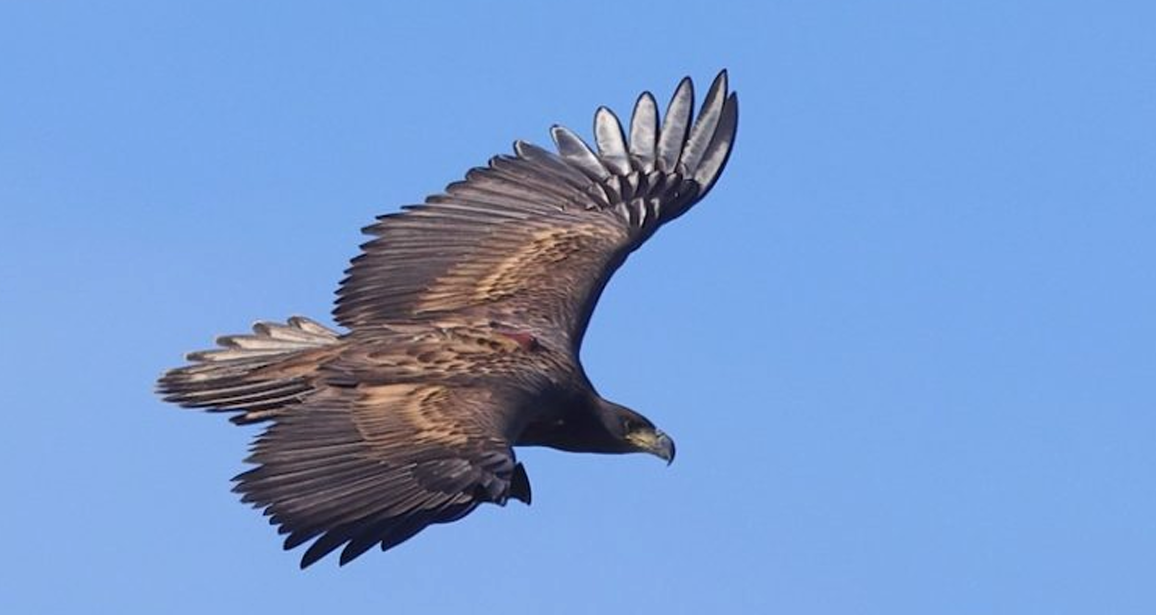
G625 photographed by Mike Gerome
We know that G471 catches bass off the South Coast and on 23rd September G625 followed his father to the coast, and then made another visit with him on 29th, before making a solo visit on 3rd October. Such experiences will be invaluable for the young male as he becomes independent. He remains in his natal territory most days but there are signs that he is becoming more self-sufficient. It was particularly encouraging that he was seen catching a fish for the first time on 11th December, by Ben Ayling. It will be fascinating to see at what point G625 finally decides to leave the area, or whether he will wait until he is pushed away by his parents once the new breeding cycle begins.
Establishing pairs
While G405 and G471 were the only pair to breed this year, two other territorial pairs of White-tailed Eagles are now well-established. G274 and G324, released in 2019, are resident on the Isle of Wight and the Solent, while G463 and G466, translocated in 2020, have paired up at Poole Harbour. This latter pair are regularly seen from the brilliant Birds of Poole Harbour boat trips which are now one of the very best ways of seeing the White-tailed Eagles in southern England. It has been wonderful to join some of these trips and to see the excitement that the birds generate. Birds of Poole Harbour are running regular trips this winter, so check out their website for more. We are hopeful that these two pairs of White-tailed Eagles will attempt to breed for the first time in 2024.
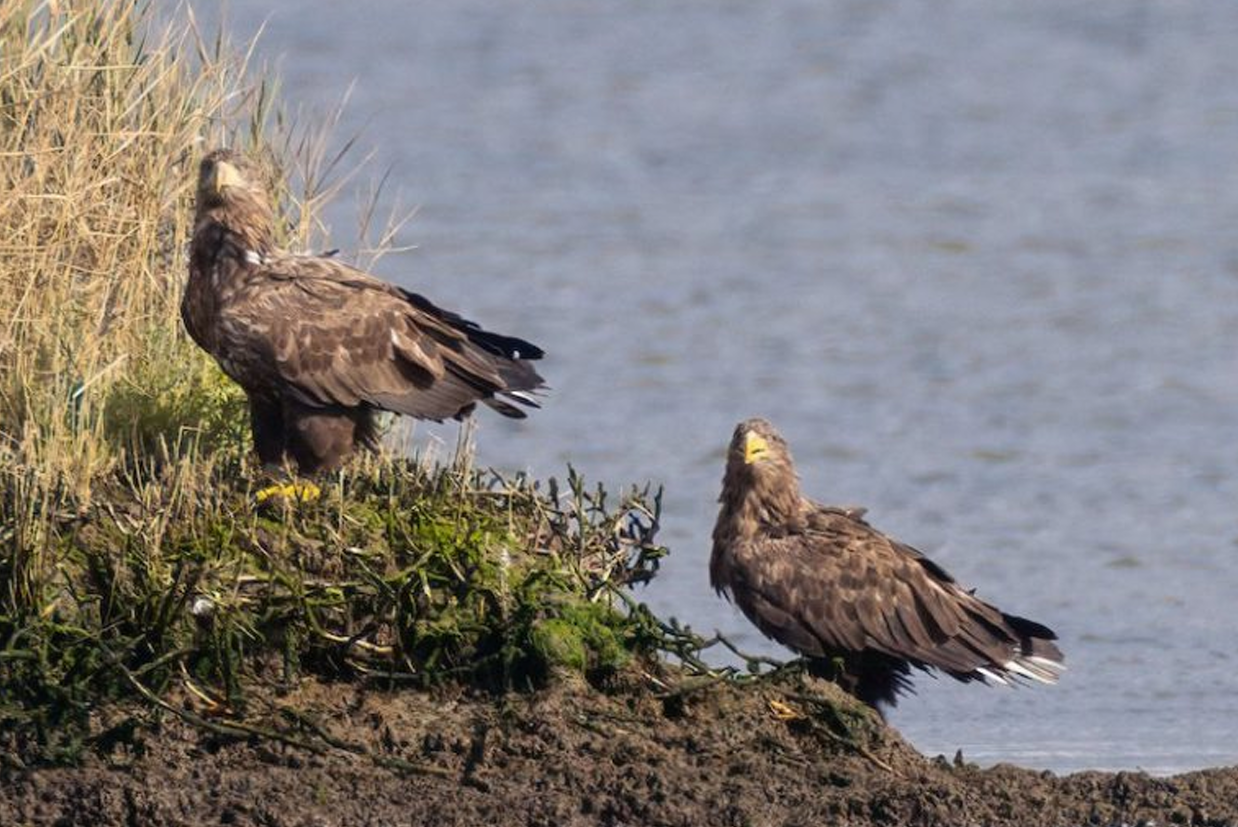
G466 and G463 photographed by Mark Wright
Sad news
Unfortunately, it is not all good news from Dorset. In early September we were encouraged that two 2021 birds, female G801 and male G816, appeared to have paired in an area to the south-west of Poole Harbour. However during the afternoon of 26th September, the satellite data indicated that G816 had been hit by a train on the main London-Weymoth line. We contacted Dorset Police and, with assistance from Network Rail, they recovered the body of the bird. A subsequent post-mortem carried out by the Disease Risk and Health Surveillance team at Zoological Society of London (ZSL) confirmed that the injuries sustained were consistent with a train strike. It seems G816 had been feeding on a dead deer close to the tracks and was then hit by the train as he attempted to fly off. Sadly, this is a well-known cause of death of White-tailed Eagles in other parts of Europe, but it was especially disappointing to lose a bird that had begun to pair-up. Thanks to Dorset Police, Network Rail and ZSL for their valuable assistance in dealing with this sad case.
Although G801 avoided the train strike, she has recently developed an overgrown bill. This has been recorded in White-tailed Eagles in Scotland in the past and can be caused by a rage of factors. One possibility is that she sustained an injury, which subsequently became infected. G801 has had several territorial disputes with the Poole Harbour female, G466, and it is possible that she damage her bill in one such incident.
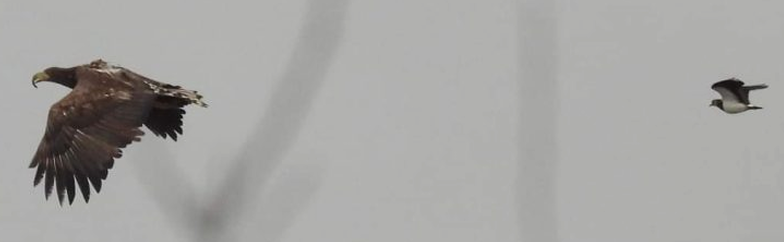
G801 at RSPB Lodmoor, photographed by Helen Wood
2022
Five of the White-tailed eagles have journeyed to Scotland this year, with another revisiting Denmark before returning.
Two birds released in 2019, G274 and G324, have formed a strong pairing on the Isle of Wight. They can regularly be seen ‘dueting’ (calling to one another), which is a key bonding behaviour. They’ve also recently been spotted occasionally carrying sticks and attempting to copulate. As the resident Island pair, they seldom tolerate any interlopers for long and actively pursue other eagles away from their territory. This behaviour is vital in establishing a reliable food resource when rearing young.
A pair of birds released in 2020, G471 and G405, have also shown early signs of forming a pair and have recently spent a great deal of time in West Sussex together.
Sadly three birds released in previous years died last winter. Post-mortem results showed that G461 died of brodifacoum poisoning.
Due to the worsening situation with Avian Influenza, we won’t release the next cohort this summer. The virus is killing many breeding seabirds in eastern and northern coasts of the UK and poses a large risk to White-tailed Eagles.
Fieldwork also indicates it is a poor breeding year for the White-tailed Eagle in Scotland, so the project team have decided not to translocate any birds this year.
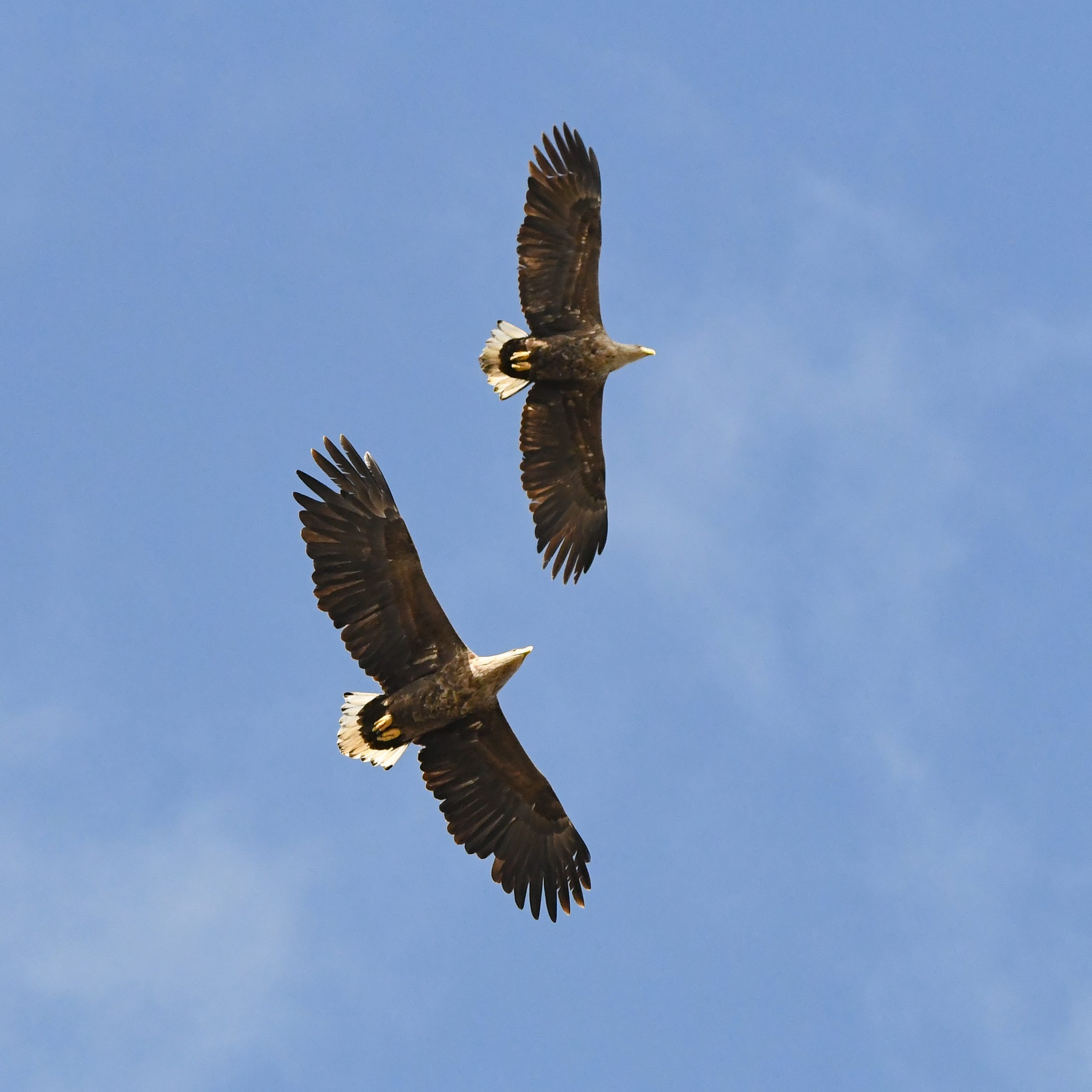
G274 and G324 photographed by Mark Harris
2021
June
Since the summer 2020 update, our white-tailed eagles have covered huge distances up to North Yorkshire and Scotland. Only one remained relatively local to the Isle of Wight. On the 20th of March all four surviving birds from the first release in August 2019 were on the Isle of Wight; this was the first time they’d all been present since September 2019. Importantly, this is the age we expect to see these birds behaving in this way. White-tailed eagles typically return to within 50 kilometres of their natal site at around two to three years old. With the establishment of territories comes a change in behaviour: a lessened tolerance for other eagles. G3-93, despite returning to the island twice, has been chased off by G274 in the first evidence of territorial disputes between the 2019 birds. Bird G274 has also shown little tolerance for the 2020 males, with both G408 and G461 returning but quickly ousted!
All six of the surviving 2020 cohort have travelled away from the Isle of Wight. Some have been visiting other white-tailed eagle populations, which is very exciting. Male G463 made a journey across the English Channel and then travelled north through France, Belgium, the Netherlands, Germany, and eventually Denmark.
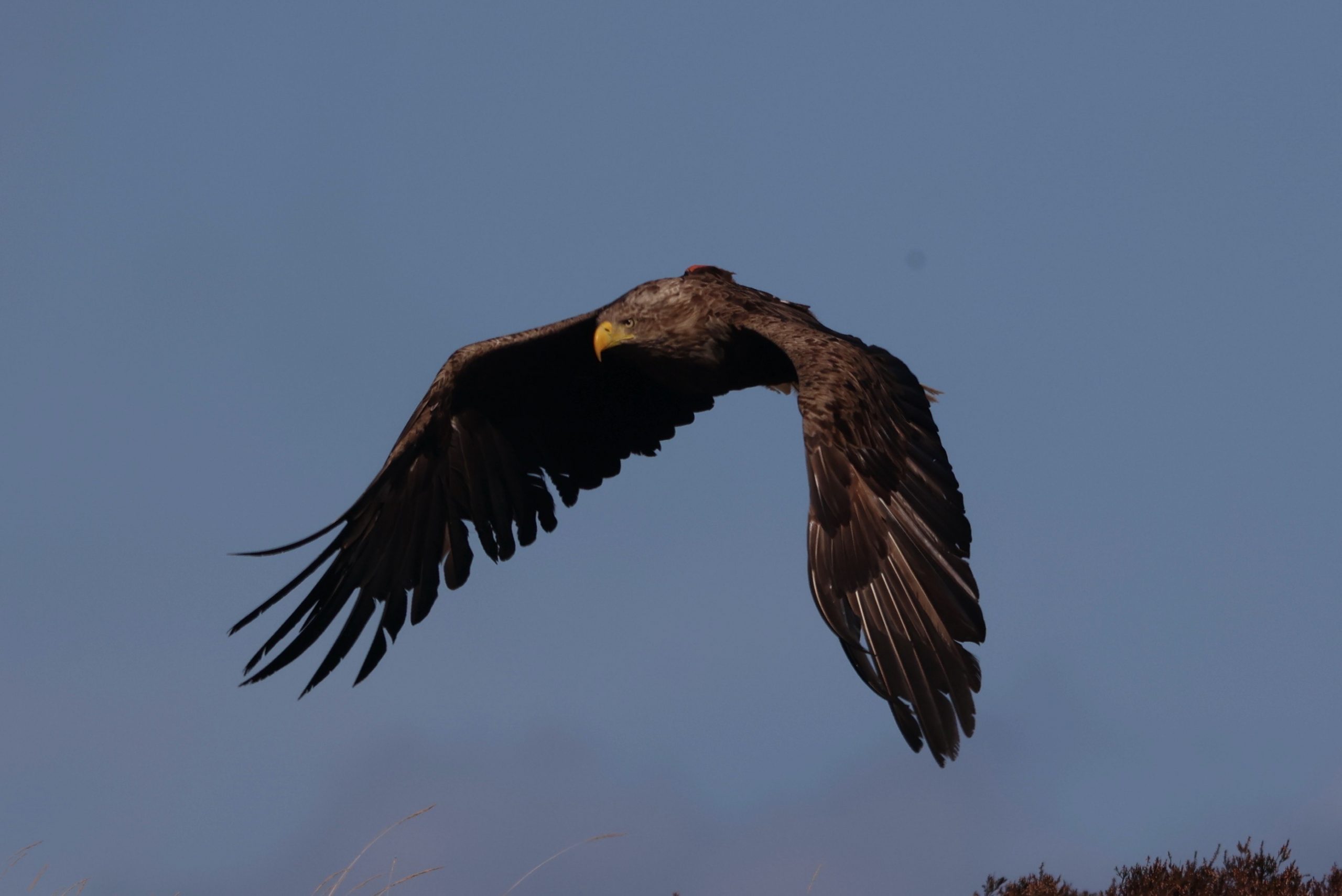
G363 photographed by Colin Chainey
2020
May
The released White-tailed eagles have spent much of the winter exploring new areas. Male bird G3-93 is famous in Oxfordshire and Buckinghamshire but seldom seen. He’s travelled since mid-March and journeyed more than 1,000 kilometres during the spring. Female bird G3-18 also left the Isle of Wight in mid-March, making a series of flights around the west country from her new base in Wiltshire. She then made a direct flight, joining G3-93 on the journey to the North York Moors.
Bird G3-24, the last of the group to leave the island, was seen several times on her six-day journey to eastern England. She took just a couple of days to reach the coast of Norfolk, but flew four days against the wind to return to the Isle of Wight.
G2-74 and G3-24 spent much of the winter together and both birds have been busy learning new skills since returning to the Isle of Wight. They have become adept at catching grey mullet along the coastline.
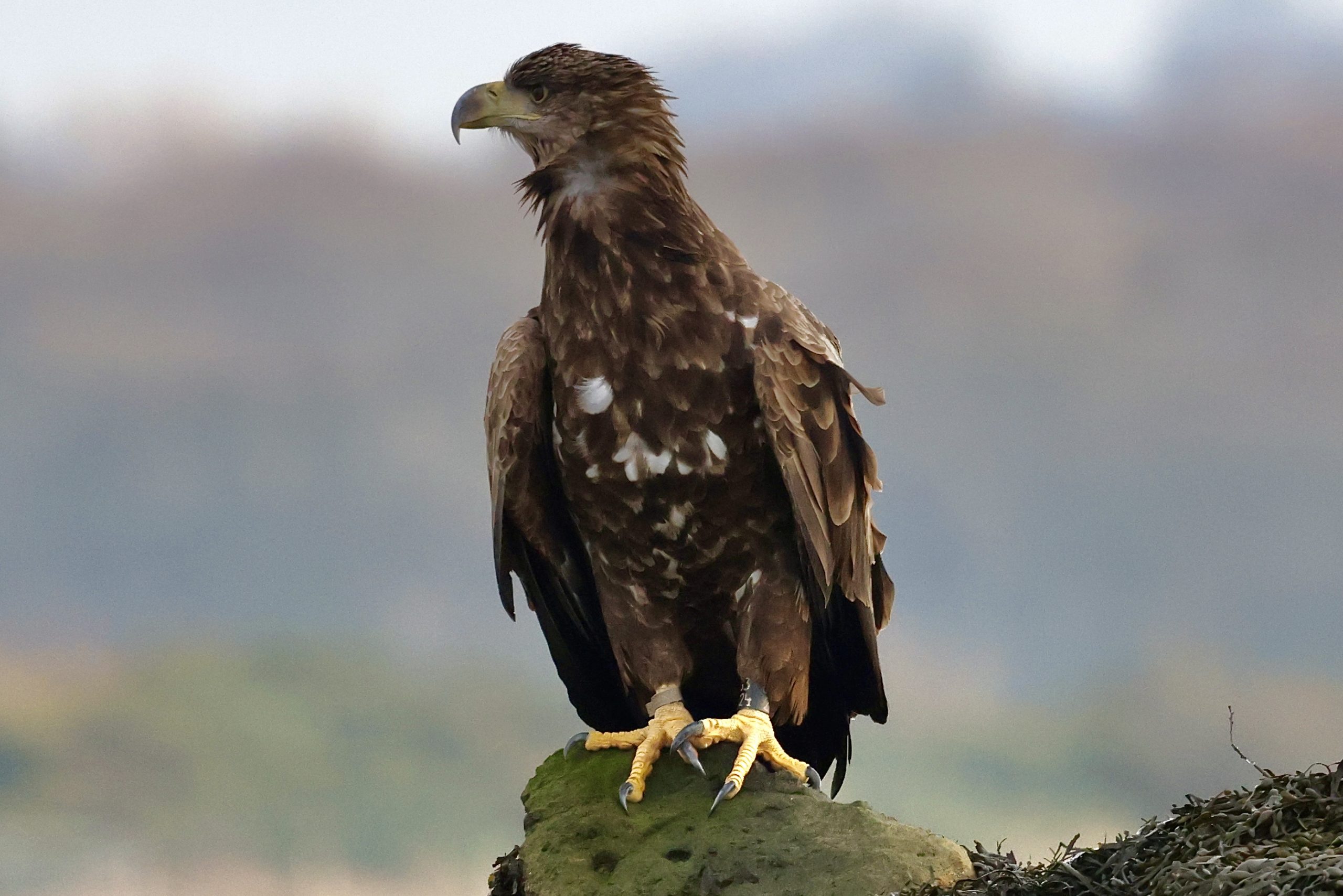
G324 photographed by Andy Burton
November
Seven more young eagles were released in summer 2020, joining the remaining four of the original six. Some of the new releases have already started exploring further afield along the south-east coastline.
G3-24 has been getting to know the newly released birds, observing them and spending time in the same areas. Young white-tailed eagles are sociable, sometimes quarrelling over food but otherwise tolerant of one another.
G2-74 stayed local throughout the summer, regularly catching grey mullet, cuttlefish and gulls, or heading inland for rabbits during poor weather. G4-53 sadly died during the autumn following a collision with a power line.
2019
March
Following extensive ecological assessment and social consultation, the feasibility study for reintroducing White-tailed Eagles Haliaeetus albicilla to the Isle of Wight and the Solent (Roy Dennis, Tim Mackrill, Jay Doyle and Leanne Sargeant) is finalised and the relevant licenses from Natural England and Nature Scot are issued.
July
The first meeting of the Isle of Wight White-tailed Eagle steering group is held, providing updates and sharing input from key stakeholders throughout the region.
August
The project starts with six young birds from Scotland being released at a private location on the Isle of Wight.
September
Following the release, the young birds are each doing well exploring their new range, one male juvenile has so far covered 680km. It’s typical for many young White-tailed Eagles to be vagrant, travelling large distances before they establish their own territory at breeding age.
October
Most of the juvenile White-tailed Eagles remained on the Isle of Wight and the surrounding Solent coastline, while two made longer exploratory flights and another ventured to Oxfordshire. They are foraging and roosting successfully, developing their natural skills.
Sadly, one of the young eagles that had remained on the Isle of Wight after release died.
December
Three birds remained on the Isle of Wight and one in Oxfordshire. Many of the young Eagles still return to the feeding stations nearby the release site, whilst continuing to forage and hunt independently.
Two birds (female G324 and male G274) were recorded spending time together, roosting in the same copse (and sometimes even the same tree). White-tailed eagles don’t breed until they are four or five, but some pair bonds do establish earlier than that.