2001 – 2025
Honey Buzzards in the UK
The Foundation has undertaken extensive research for Scottish Honey Buzzards since 2001, including innovate satellite tracking and nest camera data analysis.
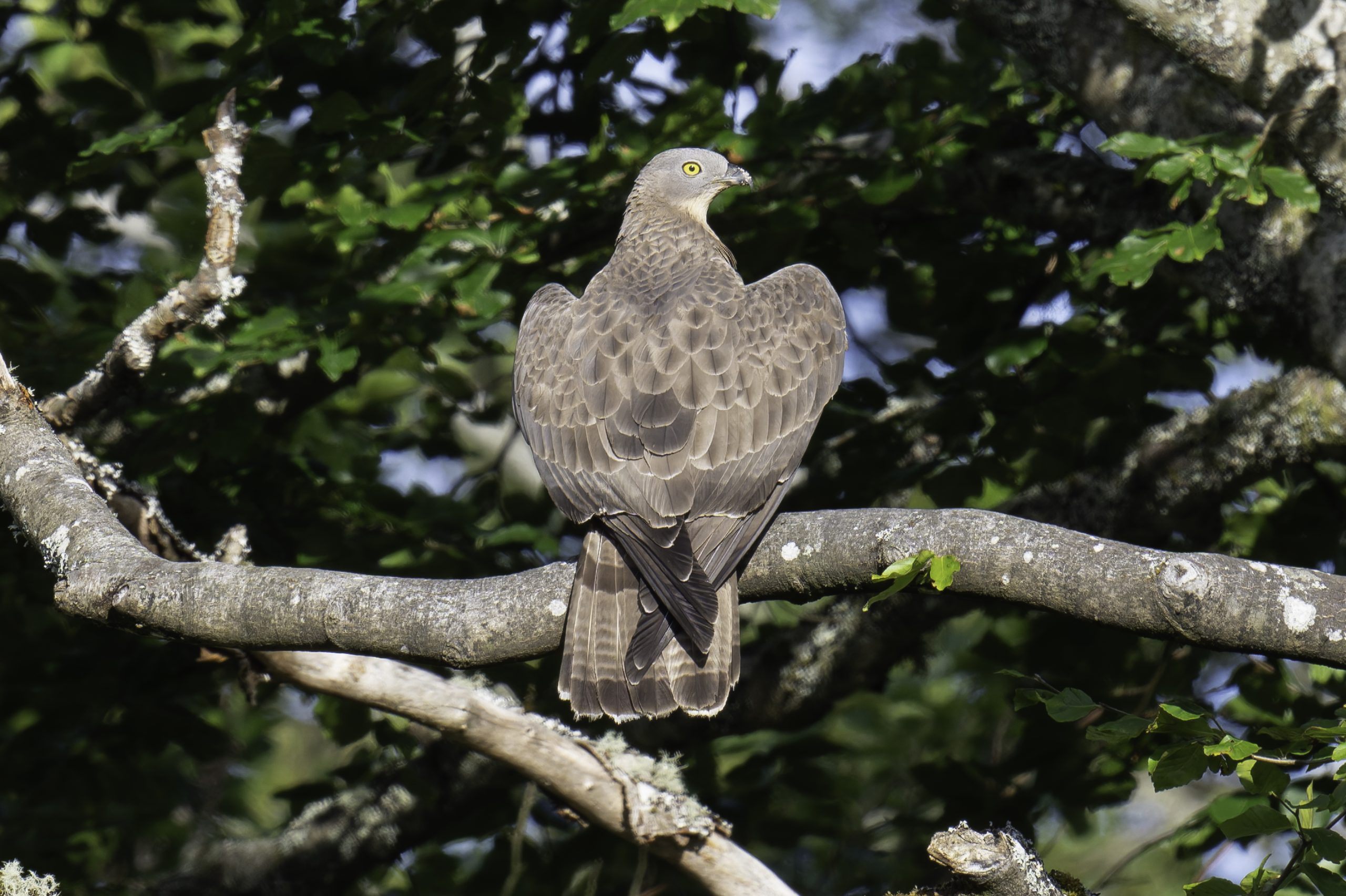
Image: Mike Crutch
About the Honey Buzzard
Honey buzzards exhibit sexual dimorphism, which is unusual for large birds of prey. The most obvious difference is the colour of the head: grey in males and brown in females. The upperparts of females are also darker than males, and the pale underparts are more obviously barred. In both sexes the tail is barred, with a dark band at the top and two or three bands near the base. Honey buzzards are slightly longer in length than common buzzards, particularly in the tail.
Image: Laurie Campbell
habitat and distribution
Honey buzzards are one of the most abundant birds of prey in Europe. The population is estimated to be around 160,000 pairs, the bulk of which are found in Russia. They are forest dwellers and are highly secretive, moving between trees and rarely being seen within the wood.
diet
Honey Buzzards are unlike other large raptors in that they specialise in eating insects, with wasp and bee larvae making up a large part of their diet. They have adaptations that protect them from stings and help them deal with their prey: their legs and feet are heavily scaled and the feathers around the bill are dense and scale like. The bill is long and curved with an extended point suitable for holding insects, and their nostrils are reduced to long slits that are less likely to become blocked with soil or wax as they dig for wasp nests. They are not entirely dependent on insects; frogs, young birds and even some fruit are taken as alternative prey.
reproduction
Honey buzzards are a migratory species, breeding in Europe and over-wintering in Asia and Africa. They arrive at their breeding grounds in mid May and nest in woods. They prefer deciduous trees and build nests made of twigs and lined with fresh leaves, normally building a new nest each year. The average number of eggs laid is two (range 1-3), and the 30-37 day incubation is shared by both parents. Although the eggs are laid a few days apart, there is not normally any aggression between the siblings as food is usually plentiful. Both adults forage and feed the chicks and after fledging, the young continue to be fed by the adults for about a month, sometimes less. In September honey buzzards migrate from their breeding grounds in Europe and Asia to sub-saharan Africa and southern Asia, where they find adequate food supplies during the winter months
Status and threats
European honey buzzards are classified by the IUCN as ‘Least Concern’. Scottish numbers have increased in recent years but many nest locations are still kept secret due to the threat from egg collectors. They are strongly affected by disturbance to breeding areas and many are shot each year in the Mediterranean during their annual migration. Within the UK honey buzzards are strictly protected under Schedule 1 of the Wildlife and Countryside Act 1981 and The Nature Conservation (Scotland) Act 2004. They are also included on the Amber List of UK birds of conservation concern. It is an offence to intentionally take, injure or kill a honey buzzard or to take, damage or destroy its nest, eggs or young. It is also an offence to intentionally or recklessly disturb the birds close to their nest during the breeding season.
Analysing nest camera data
Nest cameras enable non-invasive remote monitoring of rare species such as Honey Buzzards, and provide an important insight into diet and behaviour during the breeding season.
Scotland 2021 & 2025
The Foundation monitored a successful pair of Honey Buzzards on the same nest in Scotland in 2021 and four years later in 2025.
The nest camera in 2025 recorded data from the 5th of August, enabling the analysis of prey deliveries to two chicks from four weeks old to the point of fledging.
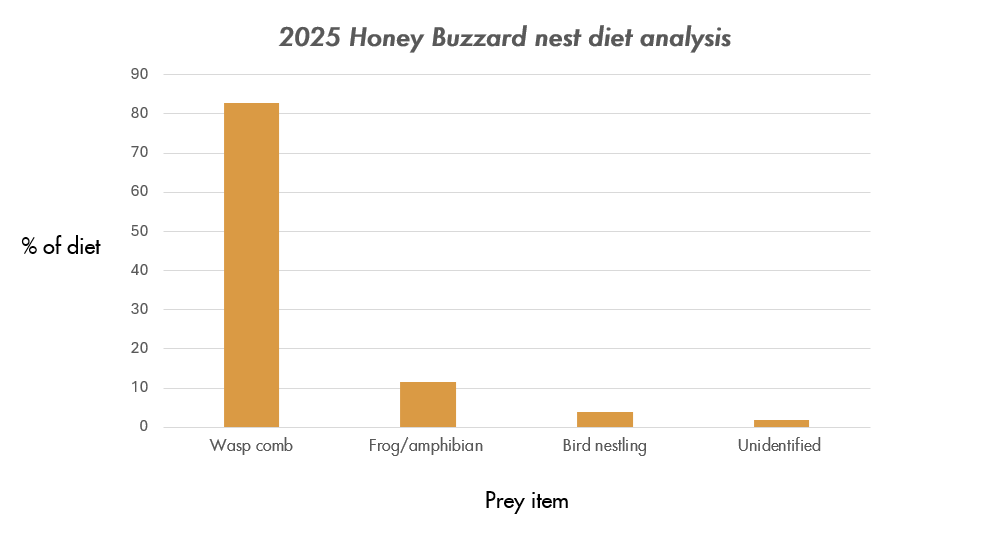
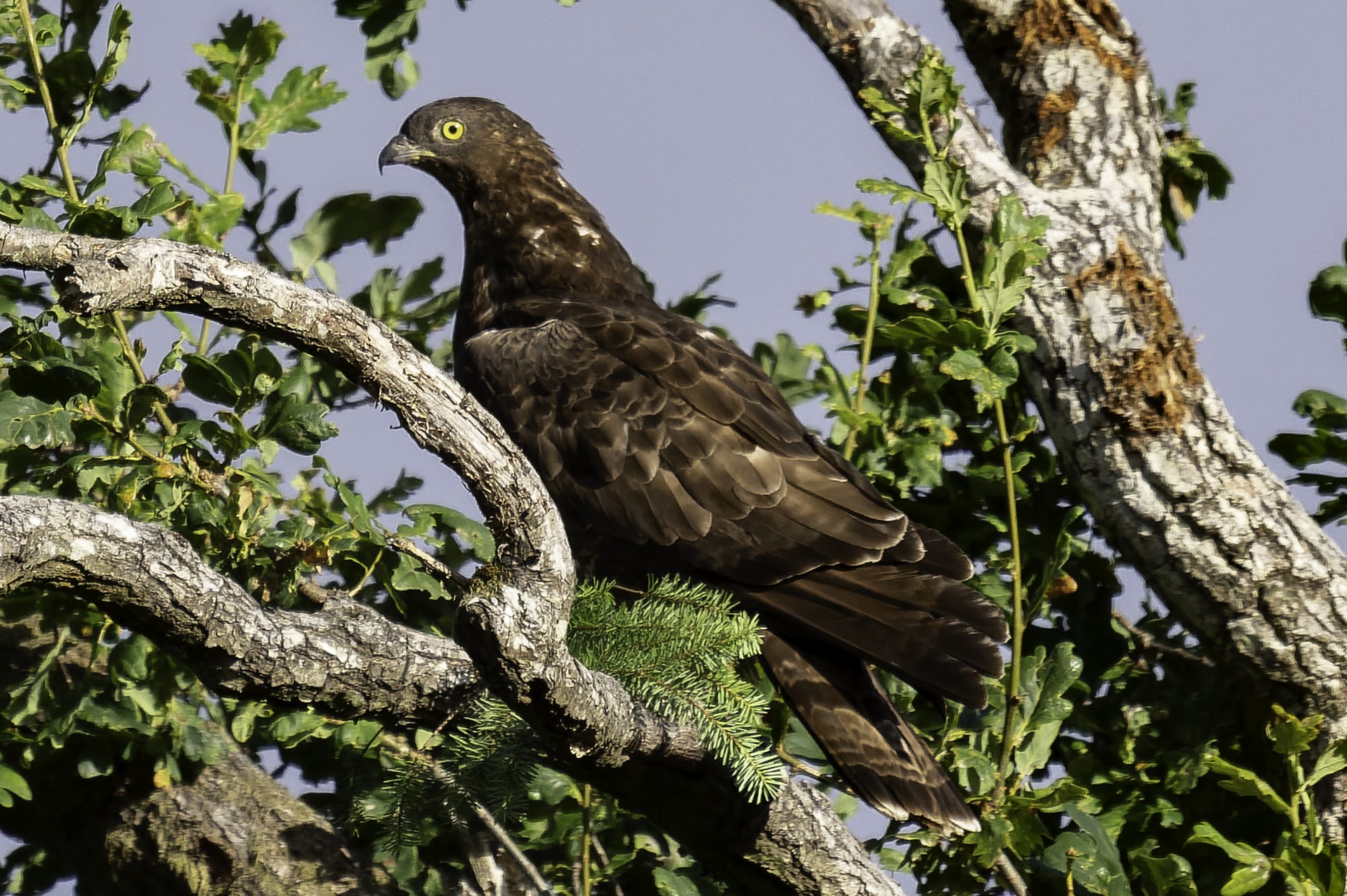
Image: Mike Crutch
Satellite tagging
We have been carrying out research on the migrations of Scottish Honey Buzzards through fitting satellite transmitters since 2001. To date we have tagged 11 young and one adult.
Two young were tagged in 2001 and one in 2002, as well as the adult male of all three chicks in These birds were from a nest on Forestry Commission land near Inverness and provided very important information about the migration anomalies of young honey buzzards from Scotland. The male wintered successfully in Gabon, and his migration was accurately monitored to the wintering quarters, while one chick was tracked to Morocco before the battery ran out. The other two perished in the Atlantic Ocean after making southerly migrations with a westerly bias. Two young from southern England were also successfully tracked to West Africa in 2003.
Unfortunately no suitable nests were located in the following years but in 2006 we are continued our research on these fascinating birds and two young were tracked to Africa. In 2007 it was a very wet summer and wasps were scarce – as were sightings of honey buzzards. In late August, Roy Dennis found one nest with a just-fledged single chick. In 2008, Roy located a nest in Moray in July and ringed two young and the larger female chick was fitted with a Solar PTT100 satellite radio. In summer 2009, we ringed and satellite tagged the two chicks from this nest; one wintered in Nigeria and one in Cameroon – both transmitters were of the old non GPS type but data was received for over a year for Rana and 1.5 years for Vespa. Unfortunately, in summer 2010 we located no successful nests, but in 2011 Roy found the new nest 1km away from probably the same pair as bred in 2008 and 2009. The 2011 summer was very poor with lots of rain and winds, and wasps were scarce. Roy found the occupied nest on 13th August and the surviving chick was tagged on 19th August.
Our honey buzzard satellite tracking studies are a partnership project between Forestry Commission, The Roy Dennis Wildlife Foundation & The Highland Raptor Study Group.