THE ARCHIVES
Conserving and satellite tracking Curlew
Curlew throughout Britain have declined extensively due to habitat reduction as a result of intensive agriculture, draining of wetlands and afforestation. They are listed as ‘Near Threatened’ by the IUCN. Roy Dennis worked with the Highland Ringing Group in 2009 to satellite tag a migrating female bird.
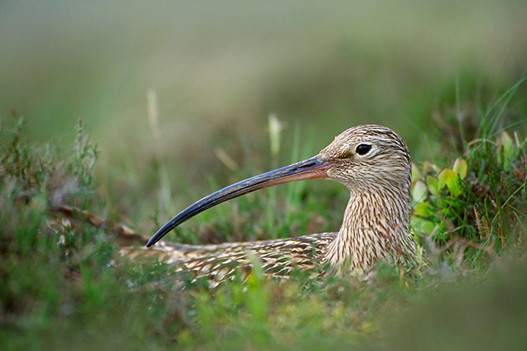
Image: Laurie Campbell
DIET
The Curlew’s diet varies depending on the season. In winter they use their long bill to probe into soft mud for crabs, ragworms, lugworms, cockles, marine snails, shrimps, small shellfish and earthworms. In summer they feed on insects and larvae, spiders and worms
REPRODUCTION
They are ground-nesting birds and do not have a traditional ‘nest’ as such; rather, the male
makes several scrapes in the ground, one of which the female selects in which to lay eggs. She lines it with suitable nesting material and lays 2-5 eggs. Both parents share the 27-29 day
incubation. The chicks are able to feed themselves once they hatch and the female often departs before they fledge, at 32-38 days.
THE ARCHIVES: 2009
Satellite tagging
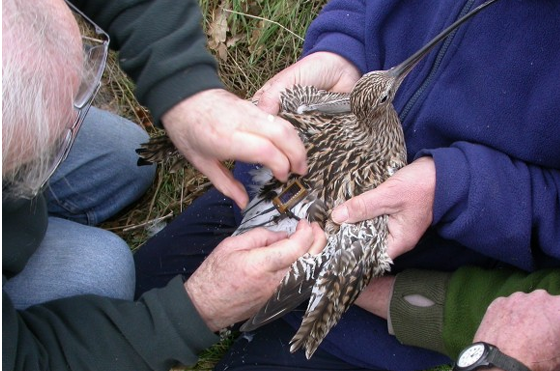
Brian Etheridge, Bob Swann and Jacquie Heaton of the Highland Ringing Group caught a small number of curlew at Bunchrew Bay on 31st March 2009. We had decided that we would fit one of our transmitters to a late migrating individual. HRG has ringed many curlew over the last several
decades on the Moray Firth and the adult curlews which hang on into April are the ones most likely to migrate to Scandinavia. Roy Dennis joined them to fit the transmitter to one of the curlews, and it was decided to choose the biggest female – with a wing 308mm, bill 150mm and weight 983 grams. She was released with a second bird and they flew out into the Beauly Firth.
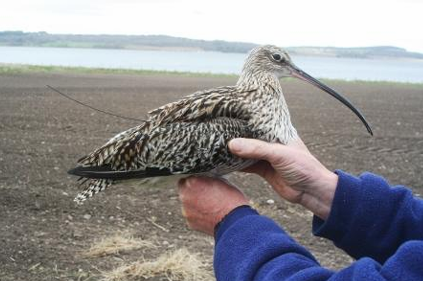
A signal on April 21st showed that the curlew had started her Spring migration and was over Norway. She arrived in Umea, Sweden the next day, then stopped on the Swedish coast for 9-12 days. She arrived in Finland on May 4th after a migration of 1895km. She spent the breeding
season in an area of farms, woodland and rough grounds near a small river to the east of Ruukki. She began her autumn migration on July 27th and arrived back in Scotland on July 1st. By the 5th she was back in the Beauly Firth.